The nice thing about having someone program for you is being told how many sets and reps to do for each exercise. But how does your coach know what to tell you to lift? Why does one person get a 5×5 at 80% of their 1RM and another gets 3×20 to failure? It all comes down to how the body responds to the stimulus and what our goals are. Take a look at the image below:
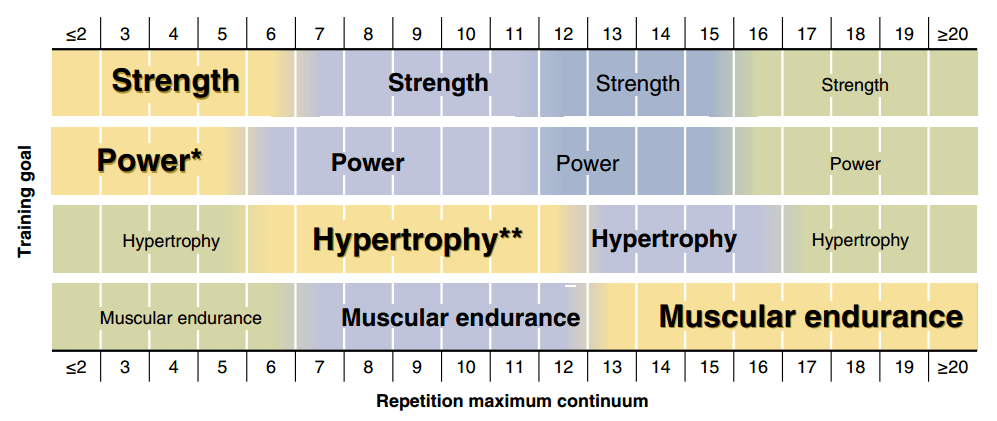
This chart (or any chart like it) is going to be your basis of all programming. We have our rep ranges at the top from <2 to >20 (less than 2 to over 20), and a colour representation for how each rep range relates to developing Strength, Power, Hypertrophy and Muscular Endurance. Before we go any further, let’s make sure we define each of those in basic terms so we know what we’re talking about:
Strength – related to physical strength, how much you can lift, increased central nervous system control over of the muscle fibers you have
Power – related to explosive strength, how fast you can generate force
Hypertrophy – breaking down and rebuilding of new muscle fibers to increase mass
Muscular Endurance – how long the muscles can work before they lack oxygen, run out of energy, or have too much lactic acid build up and need to stop and rest
Now that you know what each of those things are, another important thing to notice is that every rep range works on all four of those aspects of training, but some rep ranges are more effective (yellow indicating the most effective, blue moderate, and green the least). You can see for strength and power that the most effective range is the <2 to 5-6 reps, and anything 16 or more is ineffective. Muscle endurance is the opposite, and hypertrophy falls in the middle. So when you first start working out, this is why the 12-15 rep range is a great starting place – it’s highly effective for endurance, while being moderately effective for hypertrophy, power and strength – the best of all four worlds. You really can’t go wrong with the 12-15 rep range and I like to start with it as an indicator of where we are fitness wise.
So where do we go from here? This is where programming comes into play, and why you’ll see different programs from different trainers – this information is the basis of the workout, but how you apply it to each person individually is where the work comes in. For example, if you come to me and say you want to do powerlifting and want to train for a 1 rep max, what would you do? You would probably look at the chart and say, “I want to train for strength, so I’m going to train in the <2 to 5-6 rep range,” right? Seems logical and might be the right choice. But let’s say you haven’t done much powerlifting, and I can see that your form is not the best, and after your 3rd set of deadlifts your low back is buckling, and now the weight is struggling to get off the ground. This would indicate a “strength” problem, right? Maybe. Or, it might indicate a muscular endurance issue with your low back, core and glute muscles if your form started out okay and degraded as the reps went on. We would do some screening and tests to determine what is breaking down and why. Before we get into a strength block, we might need to do a muscular endurance block first to build up the endurance in the muscles so that you can properly perform the strength portion later. This is why we’re always evaluating and why we fluctuate up and down in weights and ranges every month. As we notice something improving, we will also notice what is now lagging behind (there will always be a weakest link in the chain and we’re constantly trying to improve them all).
This is the same reason as to why we cycle through things. You might want to start with some higher rep ranges to build up endurance, then as you improve move to some moderate rep ranges to increase our muscle mass and get stronger, then drop to the lower reps to maximize our strength – and repeat. You’ll max out your strength on what you have and then you start over. Back to endurance, add a little more muscle again, maximize strength. Repeat. If you only ever do high reps, you will burn calories but never get stronger. If you only do strength you will not burn many calories, and not see much muscle growth and will plateau on your numbers. Hypertrophy is the best mix of both and you’ll get pretty fit, but will never see maximum strength or endurance performance.
It’s up to you and your coach to always be assessing and changing programs as you and your body grow and adapt. The sign of a good coach is someone who has your goals in mind and listens to you – I would not make you do powerlifting training if your goal is to complete a marathon – the chart explains why and it should also be obvious. When you receive your programs you should be able to look at them and say, “This makes sense for me and my goals” and if it doesn’t that’s a problem!
Hope this was helpful and next week we will get into supercompensation!
 fitbusiness.ca