
After last week’s blog on rep ranges and which ones to pick for what goals, the next logical step is how to then use those rep ranges effectively (i.e. “I want to grow my legs so I should use the hypertrophy rep range, but how many times a week should I do that and when should I take rest days?”). I want to continue to hammer in the importance of consistency in your exercise and why taking a few days off to wait for optimal training conditions might be inferior to doing smaller, less exciting workouts every day. The way we do both is by looking at the supercompensation cycle.
When I was looking for some good photos I came across this little blog that summarized it extremely well: (excerpt from “What is Supercompensation Theory and Why Should You Care?” by John Ferry, June 15 2020)
What is Supercompensation Theory
Supercompensation theory states that when an appropriate training load is applied to an athlete, followed by an appropriate recovery, the athlete’s body not only returns to the previous baseline, but supercompensates in order to be prepared for a greater future training load. There are four main phases to this theory.
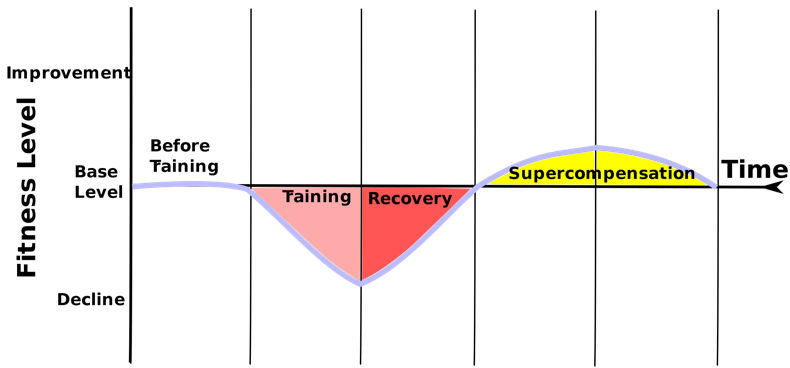
- The first phase is the application of training stimulus to an athlete. As mentioned before, it’s incredibly important that the intensity of this training be appropriate for the athlete. Training loads that are too intense will result in difficulty returning to base level. Similarly training loads that are too easy will result in little to no adaptation.
- The second part of the cycle is recovery. Supercompensation theory only works when the athlete fully recovers from the training stimulus and has peaked into a supercompensation zone. If an intense training stress is applied too soon after the initial training, not only will the athlete miss the benefits of supercompensation, but will lower their overall base level. Repeatedly overtaxing the body without properly recovering often leads to plateaued or declining performance.
- Supercompensation. If an appropriate training load has been applied, followed by an adequate amount of recovery, your body enters your supercompensation window. This adaptation to the initial training stress allows the athlete to execute at a higher level than before. If the proper training ratio of work to recovery is executed the result should be a continual wavelike training graph that leads to greater performance.
- The final phase of the cycle is detraining. If the next training load is too easy, or too long after the initial session the supercompensation window will be missed. If there is a continual pattern of workouts that are too easy or too sparse the athlete’s base level will start to decline. This is an important factor to consider when backing off intensity or entering your off-season.
So! The main points to take from this are: training stimulus (weights/load) needs to be challenging and we need to rest and recover BUT we can’t do it for too long. Hitting legs on Monday, letting them rest on Tuesday, and then hitting them again on Wednesday is great – waiting till Saturday to do them again is not. You will have applied stimulus, recovered, but missed the window for growth, and we end up in this endless cycle of returning back to baseline over and over again. This is MY personal main piece of motivation. I will not allow myself to skip my Wednesday workout because if I do, the pain I went through on Monday’s workout was kind of wasted. On the flip side, this DOESN’T mean that if you miss a workout then it’s all ruined – it’s cumulative. Getting sick, taking a few days off, needing an extra rest day, those things are going to happen, it’s just making sure it isn’t happening every single week. And even so, if you can only manage to get in one workout a week, that’s still better for your health than not getting any! Just expect to see better and faster results the more consistent you are. General fitness is much easier to maintain then a specific training goal, and both are perfectly acceptable. It’s just the difference between going for a run once or twice a week for enjoyment and health, versus training specifically for a marathon.
This is also why I program a lot of full body days versus “chest day”, “back day”, etc. Training chest once a week is going to be a lot slower for results than hitting it 2 or 3 times a week, so you’ll see maybe bench press on one day, push ups a day or two later, and chest flys and dumbbell presses another day or two later. Same with legs, squats one day, deadlifts another, and split movements in between, instead of just one day for legs a week. It also makes the program more resilient, where if you only get in 2 out of 4 days, you still hit all the muscles at least twice in the week – if you only train chest once a week and miss one, that’s two full weeks before you’d hit it again.
TLDR: Train all your muscles multiple times a week, and rest when you need to but try not to take more than 1-2 days off!
 fitbusiness.ca