This week’s topic is range of motion! Before we get into it Range of Motion (ROM) is defined as:
– Range of motion is the capability of a joint to go through its complete spectrum of movements.
– Range of motion of a joint can be passive or active.
– Passive range of motion can be defined as the range of motion that is achieved when an outside force (such as a therapist) causes movement of a joint and is usually the maximum range of motion that a joint can move.
– Active range of motion is the range of motion that can be achieved when opposing muscles contract and relax, resulting in joint movement. For example, the active range of motion to allow the elbow to bend requires the biceps to contract while the triceps muscle relaxes. Active range of motion is usually less than passive range of motion.
– Range of motion therapy is beneficial in healing and in recovery from soft tissue and joint lesions, maintaining existing joint and soft tissue mobility, minimizing the effects of contracture formation, assisting neuromuscular reeducation, and enhancing synovial movement. (excerpt from https://www.sciencedirect.com/topics/immunology-and-microbiology/range-of-motion)
Let’s take a look at squats as this one tends to come up the most. Take a look at this photo below and figure out which one is a proper squat:
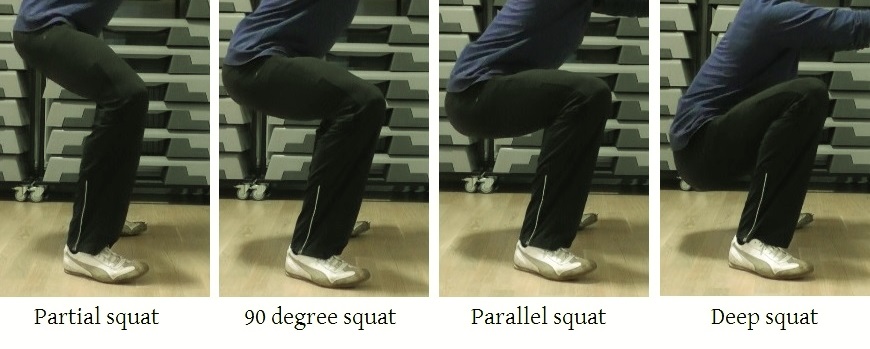
The answer is they are all squats. The difference between the images is the ROM – the first image has the smallest range and the last image has the biggest range. Each person’s body is different and going to be capable of a different range due to body mechanics, lifestyle, and training goals. The biggest two I want to focus on are lifestyle and training goals as those two go hand in hand (and body mechanics like femur length we can’t do anything about – you got the bones you got and you’re stuck with them). So, which is the squat for you? Here’s a few questions that go through my head when coaching to determine which one we’re looking for:
1. What is your current range of motion? If you can deep squat easily, then deep squat! But if you can only get down to a 90 degree then that is where we start.
2. If there is an opportunity to increase the ROM, should we? YES. I always try to increase ROM as it generally decreases your chances of injuries when done properly. For example, if you can squat parallel and are strong doing so, then your body is prepared for that movement. But if an unexpected load is added to your back (anything from a barbell to a child jumping on you) and you are suddenly forced into a deep squat it is probably an injury could occur. The soft tissues like joints and ligaments are not prepared and can tear or get strained as they get forced past their range of motion.
3. What is the purpose of your training? When you are doing any exercise you should know ‘why’. If you are doing barbell squats to burn calories but you can’t get down to parallel, that’s okay! Getting down to 90 is still going to use your legs, burn lots of calories, work up a sweat and strengthen your legs. Same thing for hypertrophy – if your goal is build muscle and burn fat, sometimes smaller range of motion will focus more on the belly of the muscle and get you more of a pump. But if your goal is to do a competition (for example a powerlifting competition) then there are standards for each lift including passing parallel on your squat and you need to train as so. I often see videos posted online of “squat personal records” with the caption saying the person is “still working on depth”. If it’s for your own personal fitness and meets your standards then that is no problem! Where you run into arguments is when people don’t agree on the standard. To someone who judges squat records like a powerlifting competition, then squatting a big weight but not hitting depth does not count. It’s like running 8 kilometers and saying your time is your new “10 kilometer personal record” but you are “still working on distance”.
The main point is – depending on what your goals are don’t let a lack of ROM stop you from trying or getting started. You have to build up strength in a partial squat before you can do a 90 degree squat, and so on. This translates over to all movements – if you are looking to burn calories and get a good cardio workout and your workout calls for burpees but you can’t do a burpee, who cares! Hip hinge, walk yourself down to the ground, lower down, do a push up from the knees and stand back up, then raise your hands over your head. Work within the range you have and actively try to increase it as you improve and get stronger, but don’t let it stop you in the meantime! Good programs and coaches will balance the demand they are asking of your body with the capacity your body has. As we get stronger and more flexible our capacity increases and then we can increase the demand accordingly.
 fitbusiness.ca