
Today I wanted to jump right into something you may not have heard of: N.E.A.T. It stands for “non-exercise activity thermogenesis” and is often an overlooked factor in gaining, maintaining or losing weight, as it can drastically impact our calories for the day in ways we might not pay attention to. We’ll plow through the science quickly and get to the “why this is important”!
First you need to know the Energy Balance Equation:
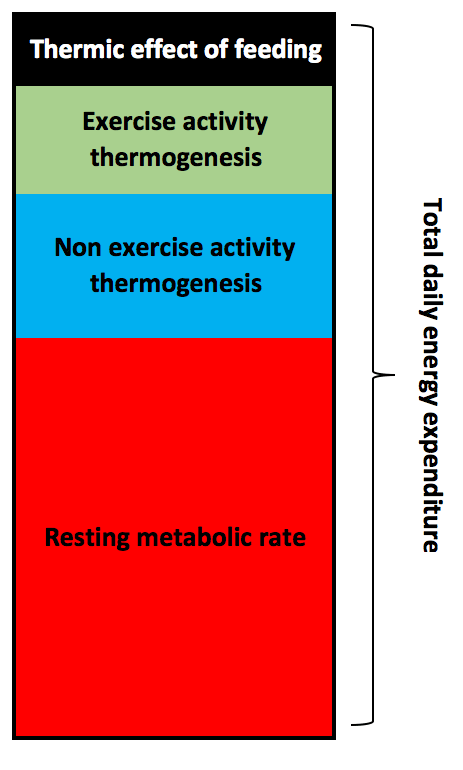
Energy Expenditure (EE) = Resting Metabolic Rate (RMR) + Non-exercise Activity Thermogenesis (N.E.A.T) + Physical Activity (PA) + Thermic Effect of Food (TEF)
It can be represented by this helpful graphic here:
Now what do all these things mean?
Resting Metabolic Rate (RMR) – This is a measure of how much energy is required to keep the body in perfect homeostasis while asleep or resting. This includes basic bodily functions such as breathing, heartbeats, and maintaining a normal temperature. It also includes the number of calories burned while eating and doing light activities such as stretching, walking, going to the bathroom, etc. It’s essentially the minimum number of calories you must expend to stay alive, and it’s surprisingly higher than you think.
Thermic Effect of Food (TEF) – In addition to using calories just to maintain our body’s basic functions, we also use calories to digest the foods that we eat. This is what’s known as the thermic effect of food (TEF). It varies considerably from food to food. Protein, for example, is harder for our bodies to digest than simple carbohydrates. Therefore, eating protein increases the thermic effect. In other words, just by trading a portion of your processed carbs for some lean protein, you’ll end up burning more calories each day.
The N.E.A.T Principle – Non-exercise Activity Thermogenesis is a fancy name to describe the calories burned from all of the movements you do during the day that is not exercise, and it can make a big difference in your fat loss program. Examples of N.E.A.T are cooking, shopping, walking, gardening. Essentially day to day activities.
Physical Activity (PA) – This is essentially intentionally planned exercise. Examples of this can be running, cycling, mountain biking, sports, fitness classes, and weight lifting.
So, for those of you who I’ve made meal plans for using the TDEE website, the TDEE stands for Total Daily Energy Expenditure and is essentially trying to estimate and calculate as close as we can to all of these factors. When it asks for age, height and weight it is trying to calculate your RMR, when it asks if you are active or sedentary through the day it is trying to calculate your NEAT, and when it asks how much you workout it is trying to calculate your PA. The only thing missing is your TEF, and it gives you a suggested breakdown of macros (fats, proteins, and carbs) to match up what foods will give you the desired outcome for your goals. This is often why we see so much protein in the diet – not just because you need protein to build muscle, but because of the increased caloric burn it has over other foods.
Next up, we want to look at the problems we could have with NEAT:
NEAT varies enormously from person to person, and can decrease when we restrict calories (the body wants to stay the same so when we cut calories WITHOUT exercising our RMR decreases instinctually and proteins like leptin set off the drive to eat more, also, when we cut calories AND exercise our body increases metabolic efficiency so that we burn less calories for the same amount of exercise)
When we cut calories and try to increase our exercise the body tries to stop us. Without realizing we burn less calories in our workouts and also become lethargic. Here’s 2 examples of how that can commonly come about:
- After a long tough workout, you decide to let the children take the dog out for a walk instead of taking your usual 45-minute walk. This may not sound like much, but this is essentially 250 fewer calories burned that day. Now add this up over the course of the week. That’s potentially 1750 fewer calories each week.
- After a long hard day of work and a tough workout, you get home and collapse onto the sofa. The thought of cooking is the furthest thing from your mind. So you order a take-away. The kind of take-away is irrelevant, but essentially you’ve deprived yourself of an extra 130 calories you could have burned up cooking your own meal, not to mention clearing up afterwards.
So what do we prioritize? If we “workout” for 4-5 hours a week, that might burn 400-5000 calories a week (it’s a big range because it depends on intensity, duration, body size, metabolic rate, you guys get the concept!), but we can also burn that much throughout the day by just being more active. For example, I walk my dog 2 times a day for 20-25 minutes each, burning about 200-250 calories each time, equalling 500/day, or 3500/week which equals a pound of weight loss a week if I’m eating my maintenance calories. So I will (in theory) stay just as lean if I completely stop working out and just keep walking my dog. Add in shoveling, cooking, cleaning the house, training clients, running up and down my 6 flights of stairs multiple times a day and I’m made in the shade.
So does this mean we don’t need to go to the gym or workout or take classes or anything like that? Seems a little counterproductive for my personal training business to email you all saying “Hey! Stop all the programs and just go for a walk!” lol. Well, if your goal is only to maintain your weight or lose a little bit of fat, and your diet is inline with your TDEE, then, yeah, that should in theory work pretty well for you! But what it can’t do for you is increase strength, muscle mass, metabolic efficiency, flexibility and mobility, change our body shape (or ‘tone’), or rehab injuries – basically all the factors we are generally talking about for “fitness”. It also doesn’t account for the fact that we enjoy a lot of these activities – group classes, weightlifting, soccer, Muay Thai, biking, skiing – I weight lift because I enjoy it and I like trying to get new personal strength records, not for my health at all. Also, depending on our lifestyles you might not have the opportunity to be more active though the day – if you have meetings from 8-6 Monday to Friday, it’s hard to tell your boss you’re going to run up and down the stairs a few times, do the laundry, and do jumping jacks while on a Zoom meeting to increase your NEAT (although I wish that was an option!).
Long story long, the less time we spend sitting down throughout the day, the healthier we’re going to be and the easier it will be to hit our weightloss goals or maintain being lean. Next week we will talk more about the TEF section of the chart and the Thermic Effect of Food.
 fitbusiness.ca
One thought on “The Secret of N.E.A.T.”