
As discussed last week we have our TDEE or Total Daily Energy Expenditure which is the total amount of energy (calories) we burn in a day through exercise, eating, walking around, doing chores, breathing, etc. The thermic effect of food is one of those ways our bodies use energy through the day (approximately 10%) and helps answer the question, “Are all calories equal?”
I’m sure you’ve heard of “negative-calorie foods” such as celery. The idea is it takes more calories to eat and digest celery than you get from eating it, so you can eat as much as you want and will lose weight because of it. Unfortunately this is not exactly the case. While these foods are not “negative” in calories, they are high in fiber and water and are very “low-calorie” foods. So they definitely serve a purpose in terms of fostering a healthy diet, supplying our bodies with micronutrients (vitamins and minerals), and water. Plus, if we fill up on veggies we are less likely to fill up on something else that may be a “high-calorie” food (as long as we aren’t smothering these veggies in peanut butter, dips or dressings).
Before we into it, let’s make note of some things that affect our TEF:
1) Age; our TEF decreases as we get older
2) Insulin Resistance; studies have shown type II diabetics and those classified as obese seem to have a reduced TEF
3) Physical Activity Level; in both younger and older adults those who are physically active seem to have a 31-45% increase in TED versus their sedentary counterparts (sedentary is considered less than 5000 steps a day, active is 10,000+ steps a day)
So next let’s look at the biggest overview, and how TEF is affected by the macronutrients we choose:
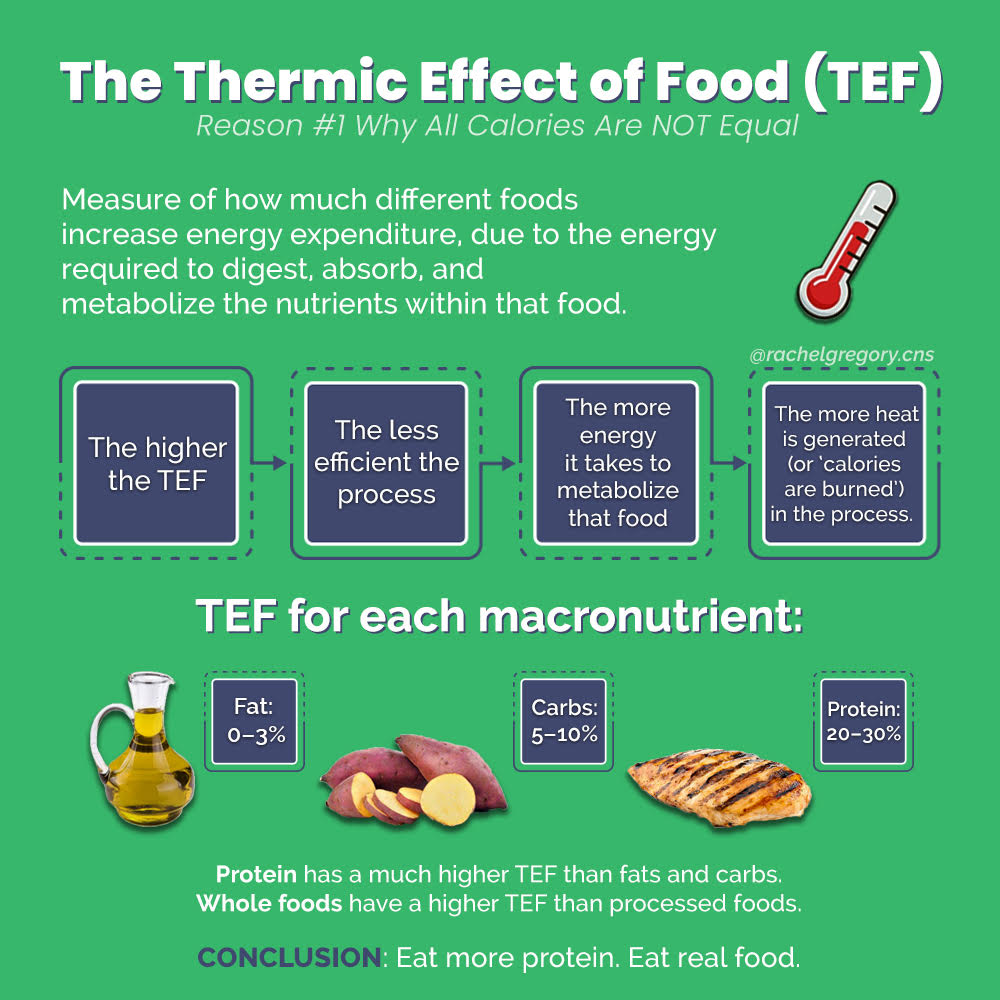
Let’s break this down with some math and some real life values of food using the images above of the olive oil, sweet potatoes and grilled chicken breast. Imagine that is our dinner. The chicken breast was done on the BBQ, and the sweet potatoes were baked in the oven with some olive oil and spices. Our meal breaks down to:
1) Chicken Breast (120g) 198 calories (4.3g fat, 0g carb, 37g protein)
2) Sweet Potato (114g) 103 calories (0.2g fat, 24g carb, 2.3g protein)
3) Olive Oil (14g) 119 calories (14g fat, 0g carb, 0g protein)
(One quick observation – look at how 1 tablespoon of olive oil is 119 calories when an entire medium sweet potato is only 103 calories. So make sure you are aware of this when cooking – salad dressing, olive oil, dips, etc, even in small amounts are more than capable of completely derailing a diet. If you just bake the sweet potato and have nothing on it, you could have TWO potatoes and it would still be less calories than the one potato cooked with a tablespoon of olive oil. Moving on!)
So, now that we have our ingredient breakdown, our total for the meal is: 420 calories (18.5g fat, 24g carb, 39.3g protein). Those 420 (419.7 to be exact) calories break into 166.5 calories from fats (18.5 x 9), 96 calories from carbs (24 x 4), and 157.2 calories from protein (39.3 x 4). Of those amounts, we can see from the chart of TEF for each macronutrient we will burn a different amount of calories for each one. It looks like:
1) Fats – 166.5 calories, burns 0-3% = 0-5 calories burned
2) Carbs – 96 calories, burns 5-10% = 4.8-9.6 calories burned
3) Protein – 157.2 calories, burns 20-30% = 31.5-47.2 calories burned
As you can see, when we eat the fats, which is the highest caloric portion of the meal, we are left with virtually 100% of those calories for our body to deal with, whereas the chicken breast supplies us with 37 grams of protein and roughly 1/5-1/3 of those calories we got from it are wiped out just by digestion and bodily functions to deal with it. It’s a much better bang for your buck! In theory, if you ate the 157.2 calories of protein at that dinner, you’d only have to burn 110-120 in exercise to stay at net zero. A similar effect happens with whole foods versus highly processed foods (I.e. eating whole grain over white Wonder Bread), they take more to break down and burn more calories to digest.
Now, this won’t be the silver bullet that changes your life, but it is something to be aware of when choosing what foods to eat and why. Depending on your goals max calories burned is not always the way to go. Sometimes we want to be in a surplus, sometimes we need more fats in our diet to support the bodily functions that require it, so it all depends on the person and what you are trying to achieve. Take care!
 fitbusiness.ca