
A lot of us are all wearing various fitness trackers (Fitbit, Garmin, Apple Watch, MyZone, etc.) and they give us a lot of information that we might not fully understand. While I mostly see these used for weight loss, I want to give an overview of how the zones work so you can optimize your training no matter what you want to achieve.
Let’s take a look at the MyZone, a common tracking system you’ll see in some class-based gyms. The MyZone comes with a heartrate monitor you wear on your chest which syncs in real time with an app, and your workout information is displayed on a “tile” on a large monitor along side other class members. The first image is an explanation of your “tile” and the second is a chart on how the zones and colours relate to your REP (Rate of Perceived Exhaustion).
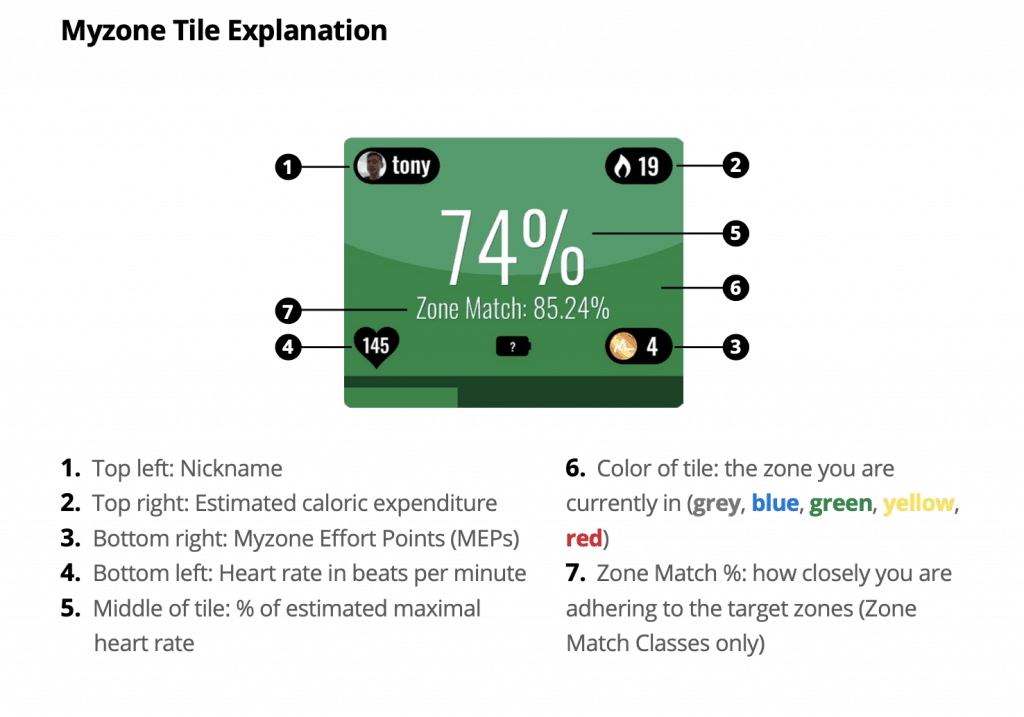
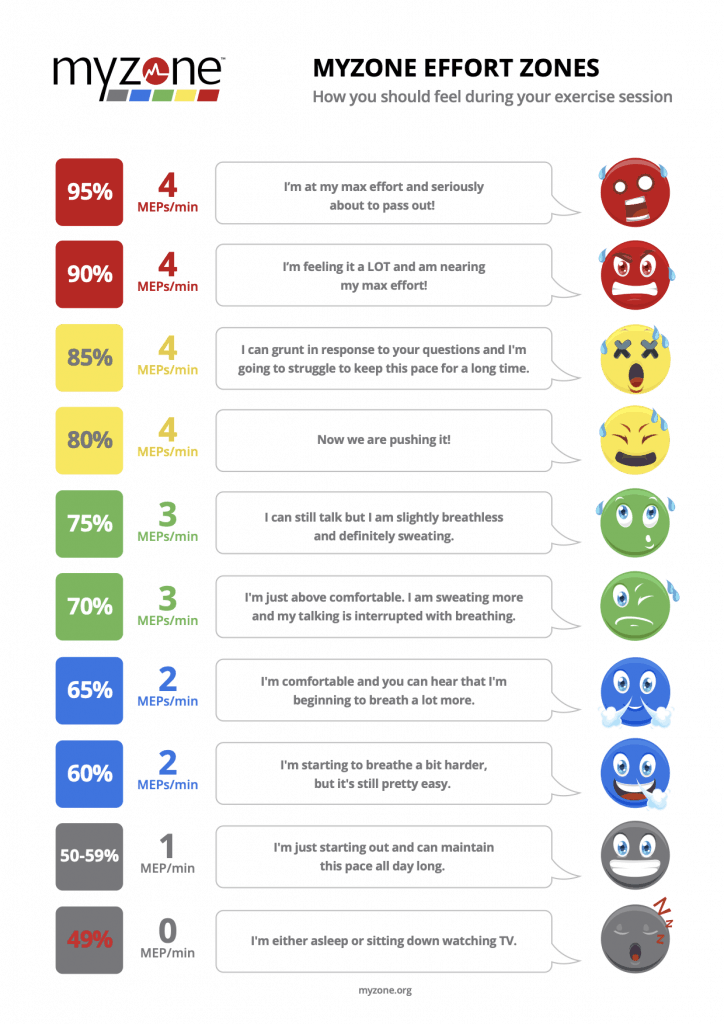
Usually with these types of trackers the harder you work the higher up in the zones you get and the more points you earn. With the MyZone you earn MEPs (MyZone Effort Points) with 1 point for grey, 2 points for blue, 3 points for green, and 4 points for yellow and red for every minute you spend in a zone. Fitbit has a similar system where you are in a resting, fat burn, cardio, or peak zone. Resting earns you 0, fat burn gets 1 point, and cardio and peak earns you 2 points per minute of activity. Usually the goal is to earn as many points as possible and the quickest way to do that is to workout at the highest intensity (i.e. 15 minutes in a blue zone gives you 30 MEPs, but 15 minutes in a yellow zone gives you 60 MEPs). This is great for encouraging more activity but it sometimes creates a false narrative that more intensity equals more fat burn and that is not necessarily the case. This is demonstrated on the Fitbit where the “fat burn” zone is just above resting and below cardio and peak. Contrary to the MyZone this seems to imply that if I workout too hard I stop burning fat. So, what does it all mean?
We need to understand the way our body balances energy. It is constantly trying to balance how much energy we take in (via the things we eat and drink) and how much energy we are using (please refer to the NEAT blog on the ways we use energy https://samanthajenningsfitness.wordpress.com/2022/02/10/the-secret-of-n-e-a-t/). As we’ve discussed, if we take in more energy than we need it will get stored in the body as fat, and if we take in too little we will use those fat stores to keep us alive (we either gain or lose weight). This is because our body has two sources of energy: fat and carbohydrates. Our activity level determines which source of energy our body will use to fuel our activity. Fats require a lot of oxygen to oxidize (to be broken down into energy for the body to use) whereas carbohydrates do not. So when our activity levels are low and we have a large supply of oxygen (sleeping, resting, light walks, house work, etc.), that is when our body is using fat as an energy source. But when we increase our activity and oxygen drops (running, jumping, boxing, HIIT classes, Spin classes, etc.), our body no longer has enough available oxygen to use to oxidize fat effectively, so it switches over to using carbohydrates.

Here is a great analogy from @jamessmithpt. Imagine your body is a Hybrid car and has two sources of fuel – electricity from the battery or gas from the tank. When you are driving at low speeds and there is a low demand on the car it is perfectly fine using electricity. But when you put your foot down to speed up or need to get up a hill, the car will switch to gas as it’s a higher source of energy. Then when the hard work is over and you can drop back down to a slower speed you switch back to electricity. I have ZERO idea if that is how Hybrid cars work in real life but for the fat and carbohydrate analogy it works.
With this understanding we can use our tools and trackers better to help us reach our goals. If we are just looking to lose weight then we want to make sure we are taking in less calories a day than we are burning and we are optimizing the lower intensity fitness zones (this is why I might give you a 20-30 minute walk instead of a 15 minute run). Weight lifting often falls in the “lower intensity zone” as your heart rate doesn’t get super high, but your body is using more fat than carbohydrates to fuel the workout so don’t stress if your watch shows you “burned” less calories in an hour weightlifting session than in an hour of cardio. If your goal is to increase your fitness and your cardio capacity though, i.e. to run faster, bike harder, and increase your VO2max, then the fat burn zones are not what you want and you’d opt for those yellow and red, or cardio and peak zones.
I hope this is helpful in understanding the info our technology gives us! If you have any follow up questions just let me know!
 fitbusiness.ca