My 1 Week of Food Tracking

This week I wanted to share my experience of tracking calories and macros over the past 7 days. The reason I keep bringing it up is because I don’t like wasting time. If I have a weight goal which I know I can achieve faster through 20 minutes of tracking a day versus months of guessing and potentially not seeing results, I know which option I’m going to take. I also see people restricting themselves unnecessarily. I gathered helpful data regarding how my calorie needs and activity greatly varied over the week and how off I was on what I thought I was burning versus what I thought I was eating. This is important for ANY weight goal, whether you are looking to lower body fat or increase muscle mass. 

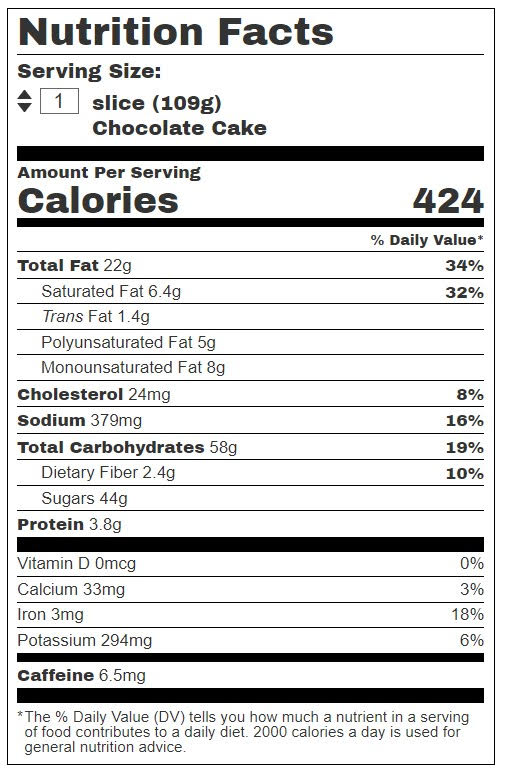
BUT FIRST I want to play a quick game: Which food fits my calorie need? (Scene) You have been invited out to the movies with some friends who are in town. After the movie you stop at a restaurant to chat over some food, BUT you are trying to lose weight. You already had dinner before the movie and you have about 400 calories left in your daily budget. Knowing that’s not a huge amount you take a look at the smaller options like an appetizer or a dessert. For appetizers they have Buffalo Cauliflower Wings and for dessert they have Chocolate Cake. 

Which do you choose? Obviously the Buffalo Cauliflower Wings because it’s a vegetable and it’s healthy, right? Let’s take a look: 
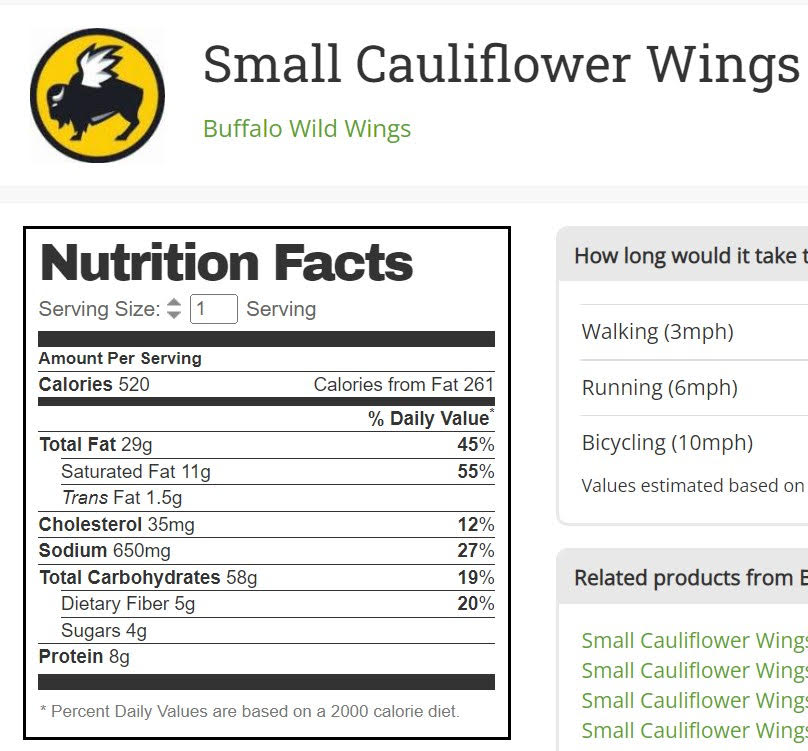
For these two examples, on a strict macro level they are basically the same. The carbohydrates are identical (because veggies are a carb – so remember when you say you want to cut out carbs that includes fruits and vegetables too!), and the fats and protein are a little higher on the wings. If we have this information available we don’t have to sit at the table sadly munching on the wings when we really want the cake. That would have been an unnecessary restriction that stopped us from having what we wanted and had ZERO benefit towards us losing weight.

(Side note: Of course this is making certain assumptions. It is assuming we are 1. at a Wild Wings and comparing a Small Buffalo Cauliflower Wings plate to a generic slice of Chocolate Cake, and 2. that you are tracking total calories only and have 400 calories available. If you make both those dishes at home, you can of course make them lower calorie, change the proportion sizes, and alter them to make them “healthier”, but for the sake of the thought experiment I simply took the first nutrition information that popped up for each food. Also when you get to the micronutrient level of vitamins and minerals, the veggies are of course “healthier” than the cake, but a “healthy” diet and a weight loss diet are not one in the same.) 

MY WEEK 

If I were to make a meal plan for myself the first thing I’d do would be to go on any TDEE calculator and get my total calories burned for the day. After putting in my data (age, height, weight, activity level) the number I get is 2,117 calories burned a day. For me to lose weight I’d want to be in a 500 calorie deficit a day eating 1,617 calories. That to me seems pretty low for my activity level but if I don’t have any data this is where I would start. Lucky for me, I’ve been wearing my Fitbit consistently for almost 6 months and it keeps a more accurate record of what I’m burning: 

Cal Out
2514
2518
2893
2651
2894
2366
2063

According to the online calculator I am burning 14,819 (2,117 x 7) calories a week but I actually burned 17,899. That is a 3,080 calorie difference. Why is this important?

If I am trying to GAIN weight (increase muscle mass) I want to be in a surplus by about 500 calories to my maintenance. The calculator says I’d need to eat 2,617 (2,117 + 500) calories a day but according to my Fitbit it would need to be closer to 3,057! If I am trying to gain muscle it’s not going to happen no matter how much I workout because I would not be in a surplus, but eating at my actual maintenance level (17,899 divided by 7 = 2,557 calories a day).

If I am trying to LOSE weight (decrease body fat) I want to be in a deficit by about 500 calories to my maintenance. This is because a pound of fat is approximately 3,500 calories (3,500 divided by 7 = 500 calories a day). If I eat what the calculator says is my deficit amount (2,117 – 500) I’ll actually be in almost a 1,000 calorie deficit a day which is way too low to function.

The goal is to match your surplus or deficit with what you are ACTUALLY burning, and we see that over the week my calories out varied quite a bit. On my highest day I burned almost 3000 calories while on my lowest it was barely over 2000. The days I am more active I need to eat more and days I am more sedentary I need to eat less.  

So what I did was I tracked everything I ate for the week – every ounce of cream in my coffee, every chocolate chip to the individual chip, every grain of rice and gram of butter. I made sure that by the end of the day I was under by 500 calories in relation to what I burned THAT day: 

Cals InCal OutDifference
20412514-473
17722518-746
22982893-595
19572651-694
22892894-605
17482366-618
15572063-506

I finished off the week with a deficit of 4,237 calories, or what should translate to losing 1.2lbs of fat (4,237 divided by 3,500 = 1.2). In reality, my weight changed a lot more: 

Starting Weight
149
148.4
147.6
147.8
146.8
146
145.4

I was down 3.6lbs in 7 days which I can attribute to some reduced bloating (not eating as much bread and sugar and snacks). I wasn’t starving on any days and it felt like the right amount of food (and all of those days still included pancakes, a beer, ice cream, and all my treats I really enjoy). The other big piece was noticing how my macro needs changed with my activity. For example, we know a good goal is to get 1 gram of protein per pound of lean body mass. I am 145-150lbs so I aim for that each day with protein (the rest of the makeup of fats and carbs doesn’t matter if the overall calories are inline). Everyday I managed to get over 100 grams of protein with the only day falling really short (Sunday). 

ProteinsFatsCarbs
13166203
14168126
16177233
14776138
16576174
1398391
10568141

In summary! Some days I burned 2063 calories, some days I burned 2893, some days I ate enough protein and some days I didn’t, some days my carbs were low and other days they were the highest thing on my plate. But I was still able to burn fat and retain/build muscle in a trackable way because I had the information. I cannot give you weight management advice if we don’t know what you are eating (how much in versus how much out). Neither can a nutritionist or dietician. Now this is also coming from someone who is relatively healthy, has no hormone imbalances and is not on any medications. Those things CERTAINLY come into play, but we don’t want to assume they are the culprits until we rule out the calories in/calories out equation first.  
Higher-Value Foods

In the last month or so I’ve spoken to almost all of my clients about food and the dietary changes they’d need to make to reach their goals. Workouts and daily activity are crucial for cardiac, bone and muscle health, but if we’re talking just strictly about weight loss then we need to acknowledge that the foods we eat or don’t eat are going to have a much bigger impact on our results than just exercise alone.

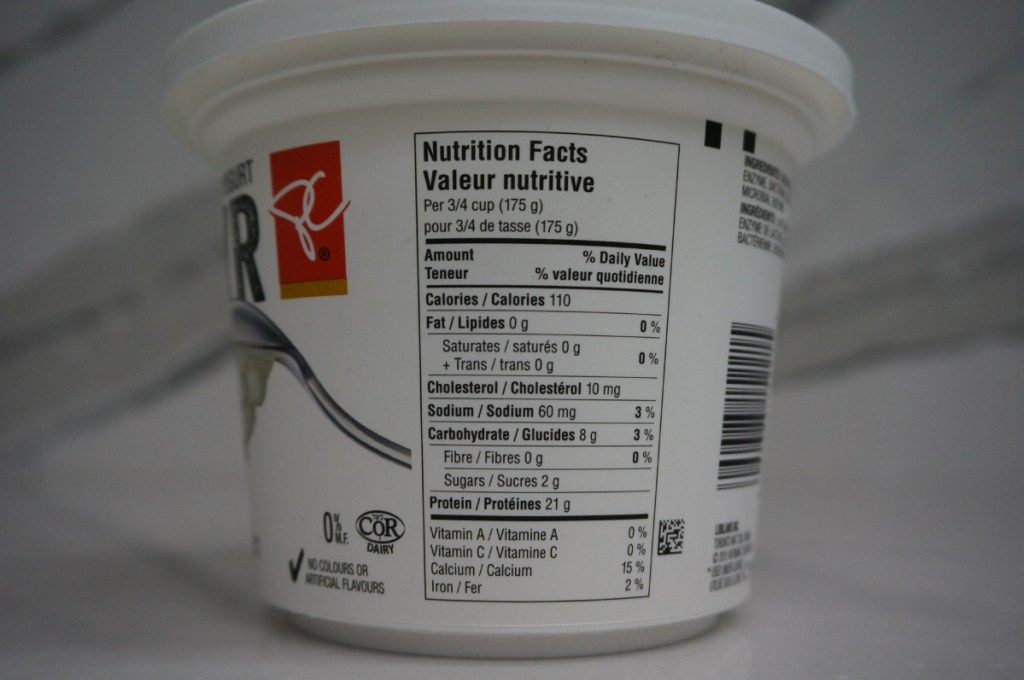
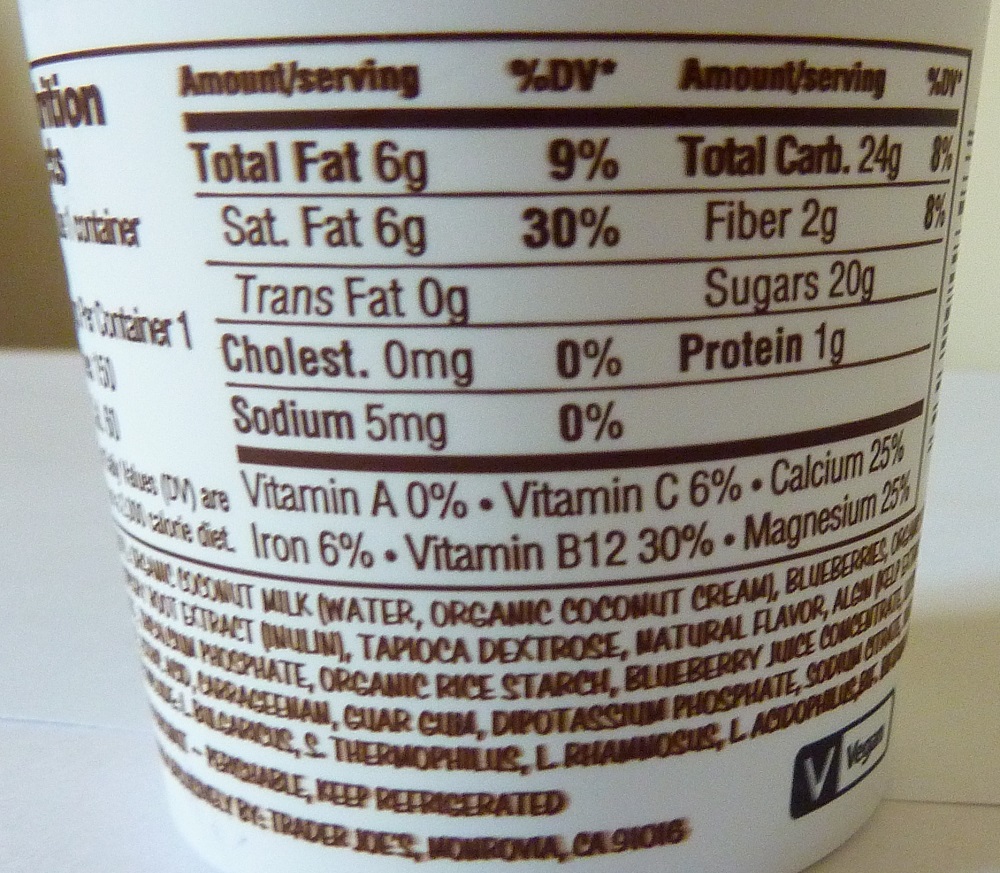
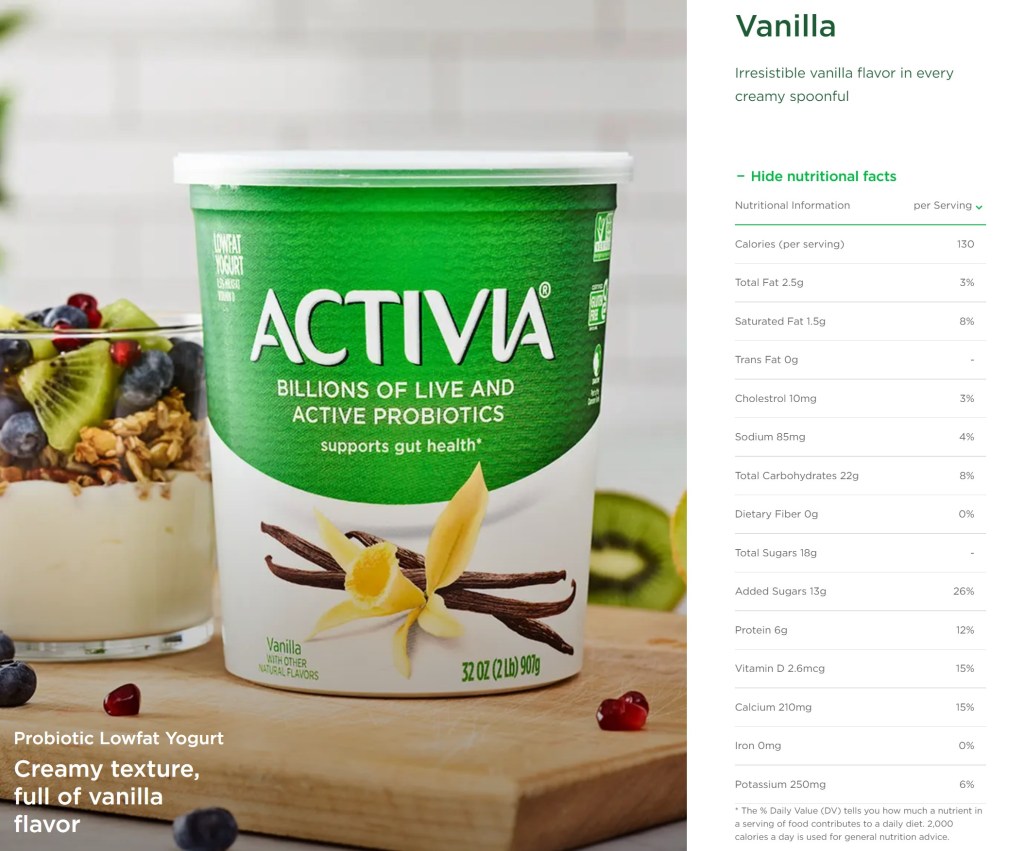
Foods are made up of combinations of fats, carbohydrates and proteins and they are not all created equal. Yogurt is a staple of most diets and nutrition plans, but depending on the brand we are going to get varied calorie profiles that can hugely impact your day. Let’s take a look at 3 different brands: 

The first one is a common ACTIVIA Vanilla ProBiotic yogurt. It is ‘healthy’, low in fat, has probiotics for the gut, and is an okay choice! For a single serving (170g) we are looking at 130 calories, with 2.5g fat, 22g carbs and 6g protein.

https://www.activia.ca/en/

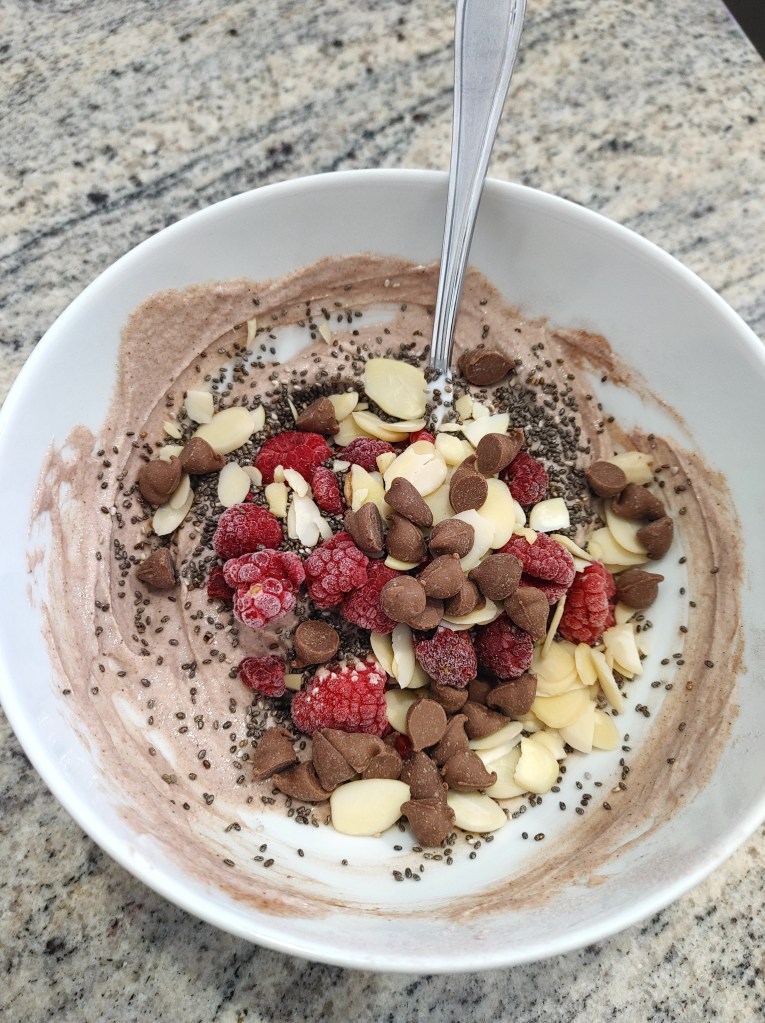
Next up we have my favourite SKYR Greek Yogurt. For a similar serving (175g) we are looking at 20 calories less, 0 fat, only 8g of carbs and almost 4x the protein at 21g. This means we are getting no fats, not too much sugar and about 10-20% of our required protein for the day in less than a cup of yogurt versus the ACTIVIA. I add in frozen raspberries for the sweetness and a scoop of chocolate protein powder isolate (25g of protein, no fats or carbs) to beef it up to 46g of protein (1/3 of my requirement for the day in 1 small snack). 

LI-SKYR Nutrition information for President’s Choice Skyr Uploaded external by: McKnight, Zoe

A third option we have is a vegan dairy-alternative, Coconut Milk Yogurt. You can’t see the total calories but for a similar serving it’s 154 calories, double the fat of the ACTIVIA, slightly more sugar, and completely devoid of protein. While it is high in vitamin B12, calcium and magnesium this yogurt is mostly oil and sugar.

This is an example of how just a small change in the brand of yogurt you buy can make a big impact on your diet and nutrition without a big overhaul. My challenge to you this week is to look for small changes in your daily nutrition that you can implement THIS WEEK. Make it sustainable, quick and achievable.

Fat Burn Vs Cardio Zones

A lot of us are all wearing various fitness trackers (Fitbit, Garmin, Apple Watch, MyZone, etc.) and they give us a lot of information that we might not fully understand. While I mostly see these used for weight loss, I want to give an overview of how the zones work so you can optimize your training no matter what you want to achieve.

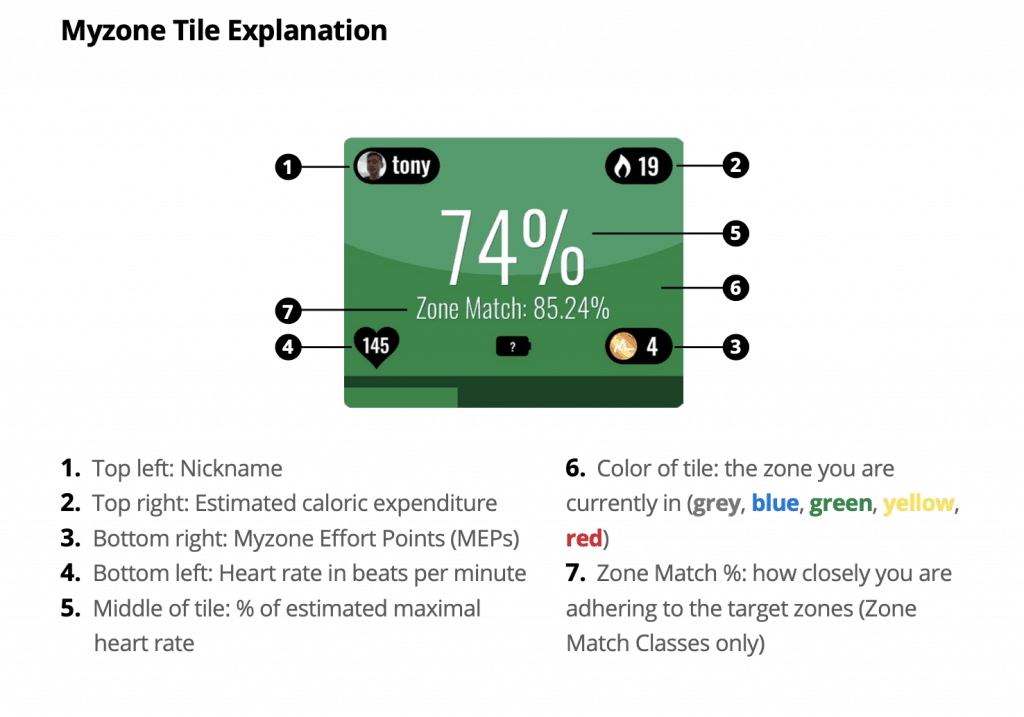
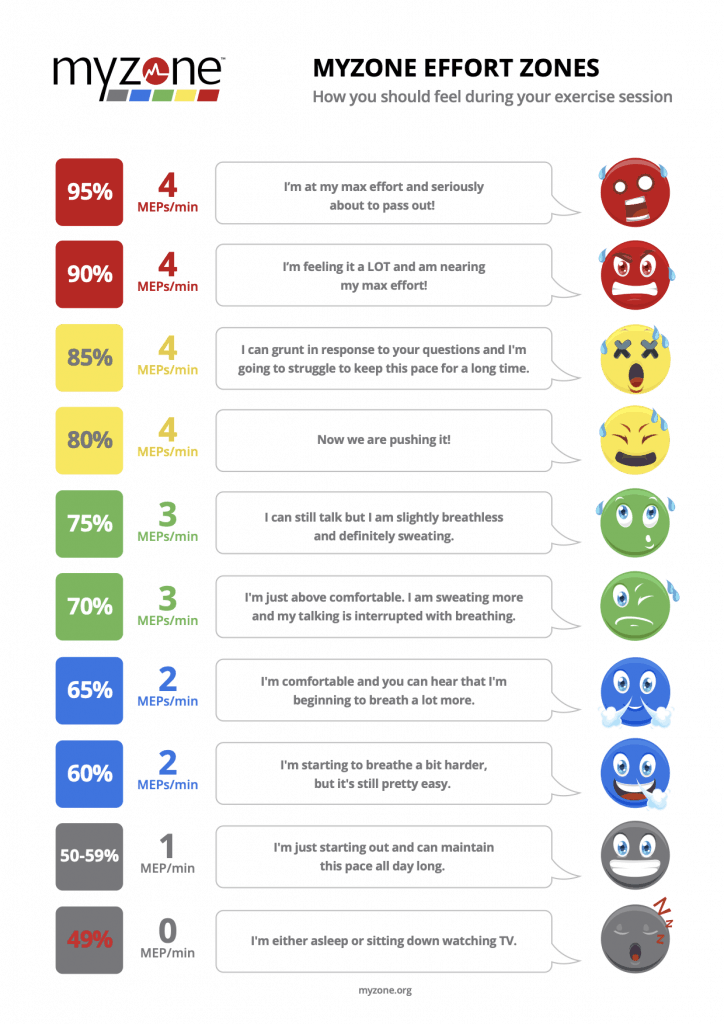
Let’s take a look at the MyZone, a common tracking system you’ll see in some class-based gyms. The MyZone comes with a heartrate monitor you wear on your chest which syncs in real time with an app, and your workout information is displayed on a “tile” on a large monitor along side other class members. The first image is an explanation of your “tile” and the second is a chart on how the zones and colours relate to your REP (Rate of Perceived Exhaustion).

 https://eliteclubs.com/10-tips-get-most-out-of-myzone/
 https://eliteclubs.com/10-tips-get-most-out-of-myzone/

Usually with these types of trackers the harder you work the higher up in the zones you get and the more points you earn. With the MyZone you earn MEPs (MyZone Effort Points) with 1 point for grey, 2 points for blue, 3 points for green, and 4 points for yellow and red for every minute you spend in a zone. Fitbit has a similar system where you are in a resting, fat burn, cardio, or peak zone. Resting earns you 0, fat burn gets 1 point, and cardio and peak earns you 2 points per minute of activity. Usually the goal is to earn as many points as possible and the quickest way to do that is to workout at the highest intensity (i.e. 15 minutes in a blue zone gives you 30 MEPs, but 15 minutes in a yellow zone gives you 60 MEPs). This is great for encouraging more activity but it sometimes creates a false narrative that more intensity equals more fat burn and that is not necessarily the case. This is demonstrated on the Fitbit where the “fat burn” zone is just above resting and below cardio and peak. Contrary to the MyZone this seems to imply that if I workout too hard I stop burning fat. So, what does it all mean?

We need to understand the way our body balances energy. It is constantly trying to balance how much energy we take in (via the things we eat and drink) and how much energy we are using (please refer to the NEAT blog on the ways we use energy https://samanthajenningsfitness.wordpress.com/2022/02/10/the-secret-of-n-e-a-t/). As we’ve discussed, if we take in more energy than we need it will get stored in the body as fat, and if we take in too little we will use those fat stores to keep us alive (we either gain or lose weight). This is because our body has two sources of energy: fat and carbohydrates. Our activity level determines which source of energy our body will use to fuel our activity. Fats require a lot of oxygen to oxidize (to be broken down into energy for the body to use) whereas carbohydrates do not. So when our activity levels are low and we have a large supply of oxygen (sleeping, resting, light walks, house work, etc.), that is when our body is using fat as an energy source. But when we increase our activity and oxygen drops (running, jumping, boxing, HIIT classes, Spin classes, etc.), our body no longer has enough available oxygen to use to oxidize fat effectively, so it switches over to using carbohydrates.

https://www.podiumrunner.com/wp-content/uploads/2020/03/fatmax.png?resize=720%2C461

Here is a great analogy from @jamessmithpt. Imagine your body is a Hybrid car and has two sources of fuel – electricity from the battery or gas from the tank. When you are driving at low speeds and there is a low demand on the car it is perfectly fine using electricity. But when you put your foot down to speed up or need to get up a hill, the car will switch to gas as it’s a higher source of energy. Then when the hard work is over and you can drop back down to a slower speed you switch back to electricity. I have ZERO idea if that is how Hybrid cars work in real life but for the fat and carbohydrate analogy it works. 

With this understanding we can use our tools and trackers better to help us reach our goals. If we are just looking to lose weight then we want to make sure we are taking in less calories a day than we are burning and we are optimizing the lower intensity fitness zones (this is why I might give you a 20-30 minute walk instead of a 15 minute run). Weight lifting often falls in the “lower intensity zone” as your heart rate doesn’t get super high, but your body is using more fat than carbohydrates to fuel the workout so don’t stress if your watch shows you “burned” less calories in an hour weightlifting session than in an hour of cardio. If your goal is to increase your fitness and your cardio capacity though, i.e. to run faster, bike harder, and increase your VO2max, then the fat burn zones are not what you want and you’d opt for those yellow and red, or cardio and peak zones.

I hope this is helpful in understanding the info our technology gives us! If you have any follow up questions just let me know! 

Is everyday too much for beginners?

Today’s topic is about volume – how much is the right amount of activity? In the DTS MasterClass last weekend we talked about training volume – how often programs need to be changed for each person’s level, overtraining and building habits. I wanted to share the key points with you all to help make workouts and training more effective, and maybe dispel some myths. 

 1. You can not over train beginners. This one comes up a lot when people are first starting a new gym routine from not previously being active. Can you start training 5 days a week? Can you get that class trial pack and go all 7 days? The answer is YES, as long as the demand of the workouts does not exceed the capacity of the person. Because your muscles and cardio system are not conditioned, you physically cannot train to a hard enough level to “over train”. This is not to be confused with doing a workout that is too advanced and pushes you past your capacity though, in which you could get injured. For people getting back into it, it is recommended to do smaller workouts and activities on a more frequent basis, for example a 15-20 minute full body routine 5-6 days a week, versus a 1 hour sweat fest 2 times a week. This is why I give all my clients homework to do the days they don’t see me – they are equally as important, if not more, for building capacity. 

2. Consistency over Weekend Warriors. We all know the person who does a 3 hour crazy workout on Saturday, is sore for 4 days, does a small workout on Thursday, rests, and goes hard again Saturday. As we noted above this is not ideal in terms of building capacity and I would question whether it is good exercise at all. We have to remember that in an increasingly digital world our bodies are still biological – they change slowly, adapt to repeated stimulus, and have their own timelines. Think about your bone density – we know with load-bearing exercises we can strengthen our bones, but how long does this take? Years, months, hours? We have some insight into this from watching a wound heal, recovering from a broken bone, or watch a child grow up. These things take time. Same with muscle building. It is a slow process that requires repeated stimulus to see any results. I found this thought experiment very helpful: 

Imagine your body is a bank account.  Every day you workout you add $2 to that account. But the cost of having the account is a fee of $1 a day. Monday you open at a $0 balance, and get your workout in. You deposit $2, and at the end of the day get charged $1 for having the account, leaving your end of day balance at $1. Tuesday you do the same thing. $2 in, $1 out, now we have $2. Wednesday, $2 in, $1 out, now we have $3. If we keep up this routine of getting in some activity everyday (our $2 deposit), but at the end of the first week we’ll have $7. That doesn’t seem like a lot, but remember, as you build that account (your capacity), you increase how much you are able to put in (how hard your workouts are). By the time you’ve saved up … let’s say $50, you are now stronger and have a higher cardio capacity than when we started – now everytime you workout you deposit $3 instead of $2, and the cost of the account stays the same at $1. Now instead of only getting $7 a week, you can save $14 a week! The results keep compounding – BUT you have to get to that first $50. 

On the flip side, let’s say we start with our first week and we workout Monday – $2 in, $1 out. Workout Tuesday, $2 in, $1 out. Off to a great start with $2 in the bank for Wednesday. But then we take Wednesday, Thursday, Friday off. That’s $0 in, and $3 out leaving us at -$1. Then we  workout Saturday, $2 in, $1 out, rebalancing us at $0. Sunday we rest again to start fresh Monday – but we’re back to $0. At this pace, every week we are saving nothing and not growing our account at all. 

3. Mobility and Physio require consistency as well. This one I can’t stress enough. As a Personal Trainer I have a very rigid scope of practice on what I can do with clients or program for you. If you have an injury or issue that is outside of my scope of practice (something that requires physio, chiro, etc.), I am bound by my certification to refer out. When you go to these appointments and are given homework (physio exercises, stretches, etc.), it is imperative that you do them daily to recover – if not, it puts limits on what I can do for you until the issue is resolved. For example, if you have a “shoulder thing” that is undiagnosed I can do the screenings and assessments I am allowed to do, within the additional courses I’ve taken to expand my scope, but I am not allowed to diagnose anything. This means I can assume what the issue is but I don’t know for sure if the shoulder issue is a torn muscle, strained tendon, shoulder impingement, thoracic outlet syndrome, nerve damage, pinched nerve, etc. (all PT’s are bound to these same requirements unless they have also obtained the education and certifications as a Physio Therapist or Chiropractor). Once we know what it is and you have a treatment plan in place, we can resume! And the more frequency with which you do the recovery homework, the faster we can get back to normal! 

Sleep Observations

We all know that sleep is good for us. When we get a quality full night’s sleep we see a host of benefits we feel immediately (“Wow! I actually feel rested today!”) and a whole bunch of other benefits working behind the scenes. I recently got a Fitbit for my birthday to track my sleep and recovery as even though I eat relatively healthy, workout in a balanced manner, and supplement with vitamins and nutrients, I still feel like something is missing. I rarely feel recovered or ready for the next day and I wanted to start figuring out why.

First, let’s recap some of the known benefits to sleep (https://www.sclhealth.org/blog/2018/09/the-benefits-of-getting-a-full-night-sleep/): 

1. Improves our Immune System Function – our immune system needs time to rest and recover just like we do, to help fight off colds and flus and other forms of sickness 

2. Helps Reduce Potential Weight Gain – when you don’t sleep your body produces ghrelin (the “hunger hormone” that stimulates food intake and fat deposition) and decreases production of leptin (mediates energy balance and suppresses appetite). So if late-night snacking is an issue for you, a lack of sleep could be partially involved. 

3. Sleep Reduced Wear and Tear on your Heart – The less you sleep the more cortisol (stress hormone) is released, and high stress damages your cardiac muscles over time. 

4. Sleep Improves Mood, Productivity, Safety and Strength – Sometimes we have to stay up late to finish work but it’s not a habit we want to get into. A full night’s sleep makes us less grumpy and increases our concentration the next day, resulting in an overall more productive day. Along with the increased focus, a study from the AAA Foundation for Traffic Safety found you are twice as likely to get into an accident when you’ve only had 6-7 hours sleep versus 8 as our reaction time slows down when we are not rested. Finally, our exercise performance is affected as well as our coordination and muscle recovery take a hit. 

5. Sleep Improves Memory – When we sleep our brain is processing and consolidating our memories from the day, and if this is interrupted we could lose those memories or create false memories. 

Most of these things we already know and I don’t think anyone is arguing that sleep ISN’T good for you. The problem is usually more: “I can’t fall asleep”, “I’m constantly waking up”, “I toss and turn”, or simply having too busy a schedule to get in 7-8 hours. I’m sure we are all aware of the tips/tricks to get better sleep: Reduce alcohol and caffeine to at least 3 hours before bed, keep your room dark and cold, avoid your phone/blue light for 1-2 hours before bed, do deep breathing exercises, etc.” The question is do they really work? Well, I think the answer is (more or less) yes. I want to show you my personal sleep data from the last few nights to draw some conclusions from. 

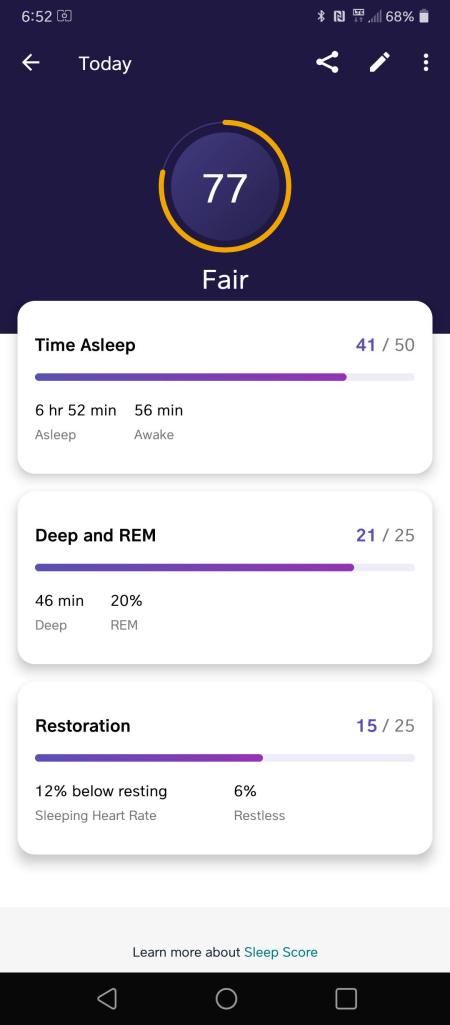
If you were to ask me what night of the week I get the best sleep my answer would be… what? I’m sure for those of us with Monday-Friday jobs, where Saturday gets busy catching up on errands from the week, the answer for most of us is Saturday night. We can usually sleep in on Sunday, catch up on sleep, and wake up feeling refreshed on Sunday morning. I would have bet money on this no problem. Normally through the week the Fitbit was giving me a sleep score of “Good” which was a rating of over 80-85/100, so I was pumped to see what my Saturday night score would be, not having to get up early and being able to just sleep to my heart’s content. Here is what I got: 

I was expecting a 85/100 or higher and a rating of GREAT and instead Saturday night, the one I was banking on to refresh me, was my worst sleep of the week. I was in bed for 8 hours – 6 hours and 52 minutes asleep and 56 minutes awake (normal amounts), my deep and REM sleep was okay, but my restoration score (the quality of the sleep) was really not good. So while I was asleep the longest out of the week, my 8 hours in bed was less restorative than the 6.5 hours I was getting during the week. WHY?? 

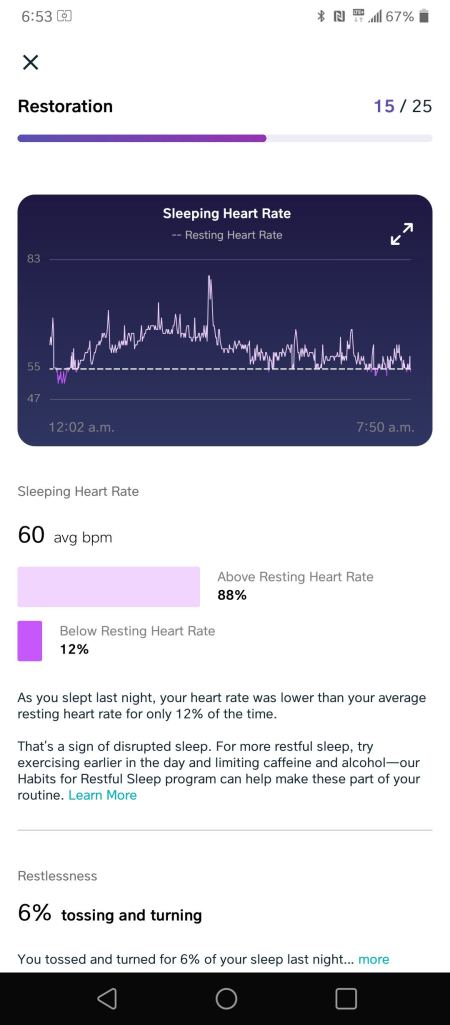
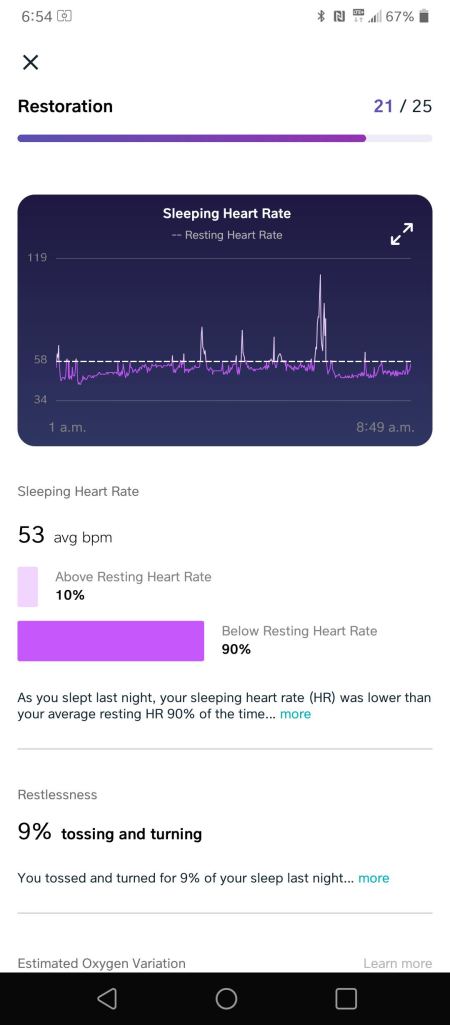
These are my Saturday night and Sunday night restoration results. Saturday is on the left: Almost the entire night my heart rate was above my resting heart rate (55 bmp) which means even though I was asleep, my body was still trying to wind down from the day. On Saturday night I had 2 beers, finishing my second one about 30 minutes before bed, and was playing a high-stress game on the computer (blue light, not winding down), right up until bed. You can see the direct result it had on my sleep – my body was still stressed out on alcohol and stimulation ALL NIGHT. The tracker also gives you a readiness score for the next day (i.e. Are you recovered enough to workout again the next day) from 1 to 100 and my score was… 4. That is dismal, I basically didn’t rest at all even though I slept 8 hours. So Sunday I decided to try no alcohol, stop gaming for an hour before bed and switch to an episode of TV that was more relaxing and the screen is farther away from my eyes, and made a small chamomile tea to sip on. The results this morning? Even though I slept 1 hour less, my heart rate was 6 points lower for 92% of the night, and I was actually at rest and recovering! That also means Sunday night put about 80% less stress on my heart muscles versus Saturday night. I woke up feeling more rested and relaxed this morning than sleeping in yesterday. My readiness score as well has bumped up to 24/100 – still not great, but we’re on the way up from a 4. 

So you can see why sleep is so important, even just from the stress side alone – if I’m having sleeps like Saturday night every night, I’m going to burn my heart out early and put myself at higher risk for heart attack and heart diseaseNot to mention never recover, always be tired, have my hormones out of whack, not be able to concentrate or be productive causing me to fall further and farther behind, always be too tired to exercise, and the list goes on. The take-away from today – NOTHING IS MORE IMPORTANT THAN GETTING QUALITY SLEEP. For those of you in the back, NOTHING IS MORE IMPORTANT THAN GETTING QUALITY SLEEP. 

In conclusion, it seems anecdotally and unfortunately that my suggestions for better sleep are the same as we’ve been toting: limit alcohol and caffeine to at least 3 hours before bed, get away from the computer and phone/tablet screens a minimum 1 hour before bed, have a nice relaxing herbal tea or hot bath/shower before bed, don’t look at the news or Tiktok or any “junk food” media (this is just a good rule in general), and get aggressive and defensive about your personal health. Just because someone else at work can’t get their things done on time and it falls to you, remind yourself that picking up their slack is literally taking days off at the end of your life, and it is not worth it

Also – TAKE NAPS! If you feel like you need one, and you can fit one in, any extra sleep is better than nothing!

The Thermic Effect of Food

As discussed last week we have our TDEE or Total Daily Energy Expenditure which is the total amount of energy (calories) we burn in a day through exercise, eating, walking around, doing chores, breathing, etc. The thermic effect of food is one of those ways our bodies use energy through the day (approximately 10%) and helps answer the question, “Are all calories equal?”

I’m sure you’ve heard of “negative-calorie foods” such as celery. The idea is it takes more calories to eat and digest celery than you get from eating it, so you can eat as much as you want and will lose weight because of it. Unfortunately this is not exactly the case. While these foods are not “negative” in calories, they are high in fiber and water and are very “low-calorie” foods. So they definitely serve a purpose in terms of fostering a healthy diet, supplying our bodies with micronutrients (vitamins and minerals), and water. Plus, if we fill up on veggies we are less likely to fill up on something else that may be a “high-calorie” food (as long as we aren’t smothering these veggies in peanut butter, dips or dressings). 

Before we into it, let’s make note of some things that affect our TEF:

1) Age; our TEF decreases as we get older
2) Insulin Resistance; studies have shown type II diabetics and those classified as obese seem to have a reduced TEF
3) Physical Activity Level; in both younger and older adults those who are physically active seem to have a 31-45% increase in TED versus their sedentary counterparts (sedentary is considered less than 5000 steps a day, active is 10,000+ steps a day)

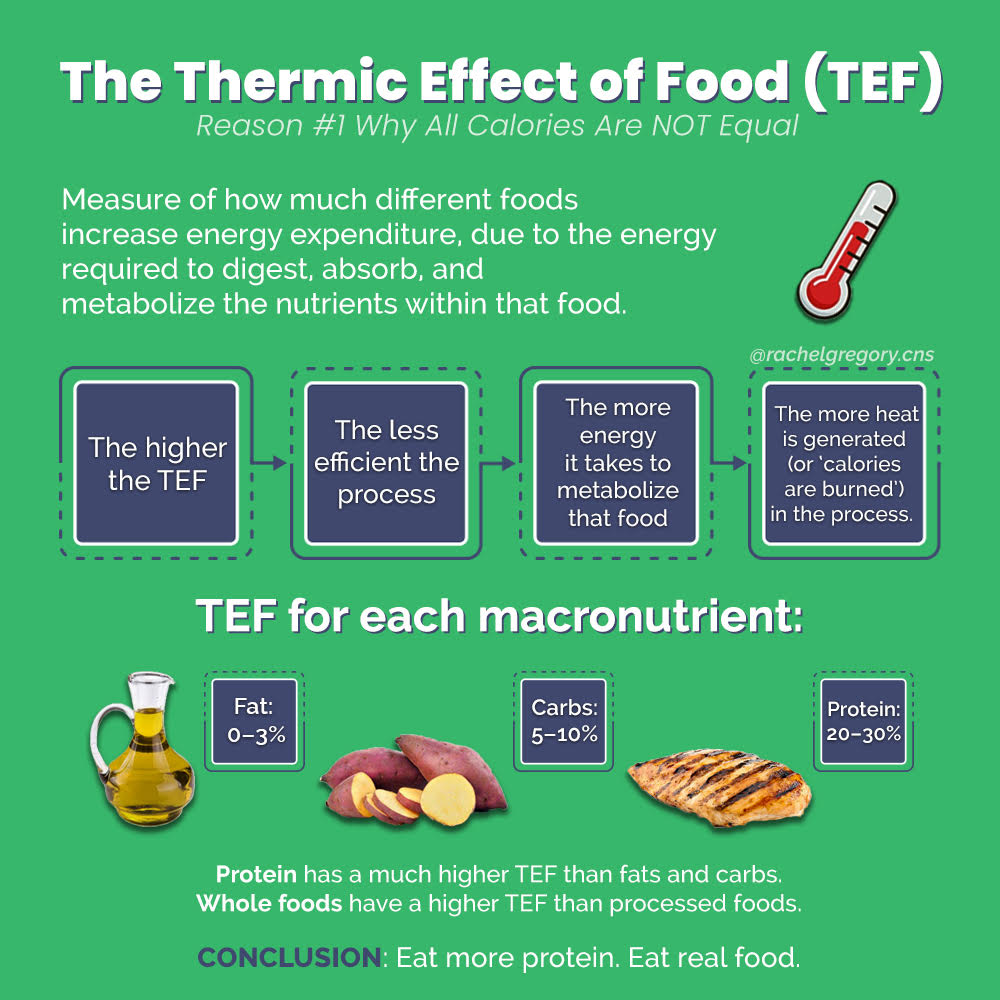
So next let’s look at the biggest overview, and how TEF is affected by the macronutrients we choose: 

https://www.metflexlife.com/blog/thermic-effect-food

Let’s break this down with some math and some real life values of food using the images above of the olive oil, sweet potatoes and grilled chicken breast. Imagine that is our dinner. The chicken breast was done on the BBQ, and the sweet potatoes were baked in the oven with some olive oil and spices. Our meal breaks down to: 

1) Chicken Breast (120g) 198 calories (4.3g fat, 0g carb, 37g protein) 

2) Sweet Potato (114g) 103 calories (0.2g fat, 24g carb, 2.3g protein) 

3) Olive Oil (14g) 119 calories (14g fat, 0g carb, 0g protein) 

(One quick observation – look at how 1 tablespoon of olive oil is 119 calories when an entire medium sweet potato is only 103 calories. So make sure you are aware of this when cooking – salad dressing, olive oil, dips, etc, even in small amounts are more than capable of completely derailing a diet. If you just bake the sweet potato and have nothing on it, you could have TWO potatoes and it would still be less calories than the one potato cooked with a tablespoon of olive oil. Moving on!)

So, now that we have our ingredient breakdown, our total for the meal is: 420 calories (18.5g fat, 24g carb, 39.3g protein). Those 420 (419.7 to be exact) calories break into 166.5 calories from fats (18.5 x 9), 96 calories from carbs (24 x 4), and 157.2 calories from protein (39.3 x 4). Of those amounts, we can see from the chart of TEF for each macronutrient we will burn a different amount of calories for each one. It looks like:

1) Fats – 166.5 calories, burns 0-3% = 0-5 calories burned

2) Carbs – 96 calories, burns 5-10% = 4.8-9.6 calories burned

3) Protein – 157.2 calories, burns 20-30% = 31.5-47.2 calories burned

As you can see, when we eat the fats, which is the highest caloric portion of the meal, we are left with virtually 100% of those calories for our body to deal with, whereas the chicken breast supplies us with 37 grams of protein and roughly 1/5-1/3 of those calories we got from it are wiped out just by digestion and bodily functions to deal with it. It’s a much better bang for your buck! In theory, if you ate the 157.2 calories of protein at that dinner, you’d only have to burn 110-120 in exercise to stay at net zero. A similar effect happens with whole foods versus highly processed foods (I.e. eating whole grain over white Wonder Bread), they take more to break down and burn more calories to digest.

Now, this won’t be the silver bullet that changes your life, but it is something to be aware of when choosing what foods to eat and why. Depending on your goals max calories burned is not always the way to go. Sometimes we want to be in a surplus, sometimes we need more fats in our diet to support the bodily functions that require it, so it all depends on the person and what you are trying to achieve. Take care!

The Secret of N.E.A.T.

Today I wanted to jump right into something you may not have heard of: N.E.A.T. It stands for “non-exercise activity thermogenesis” and is often an overlooked factor in gaining, maintaining or losing weight, as it can drastically impact our calories for the day in ways we might not pay attention to. We’ll plow through the science quickly and get to the “why this is important”! 

First you need to know the Energy Balance Equation: 

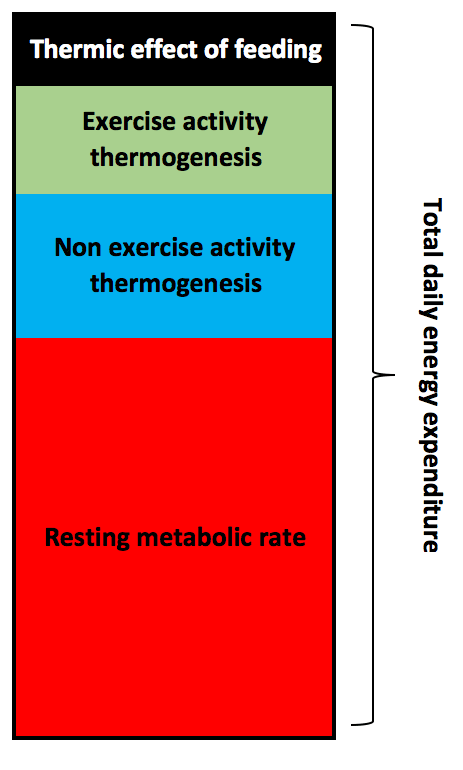
Energy Expenditure (EE) = Resting Metabolic Rate (RMR) + Non-exercise Activity Thermogenesis (N.E.A.T) + Physical Activity (PA) + Thermic Effect of Food (TEF)

It can be represented by this helpful graphic here: 

Images and definitions taken from https://strengthmatters.com/what-is-n-e-a-t-and-why-it-can-help-you-lose-fat-faster/

Now what do all these things mean? 

Resting Metabolic Rate (RMR) – This is a measure of how much energy is required to keep the body in perfect homeostasis while asleep or resting. This includes basic bodily functions such as breathing, heartbeats, and maintaining a normal temperature. It also includes the number of calories burned while eating and doing light activities such as stretching, walking, going to the bathroom, etc. It’s essentially the minimum number of calories you must expend to stay alive, and it’s surprisingly higher than you think.

Thermic Effect of Food (TEF) – In addition to using calories just to maintain our body’s basic functions, we also use calories to digest the foods that we eat. This is what’s known as the thermic effect of food (TEF). It varies considerably from food to food. Protein, for example, is harder for our bodies to digest than simple carbohydrates. Therefore, eating protein increases the thermic effect. In other words, just by trading a portion of your processed carbs for some lean protein, you’ll end up burning more calories each day. 

The N.E.A.T Principle – Non-exercise Activity Thermogenesis is a fancy name to describe the calories burned from all of the movements you do during the day that is not exercise, and it can make a big difference in your fat loss program. Examples of N.E.A.T are cooking, shopping, walking, gardening. Essentially day to day activities.

Physical Activity (PA) – This is essentially intentionally planned exercise. Examples of this can be running, cycling, mountain biking, sports, fitness classes, and weight lifting.

So, for those of you who I’ve made meal plans for using the TDEE website, the TDEE stands for Total Daily Energy Expenditure and is essentially trying to estimate and calculate as close as we can to all of these factors. When it asks for age, height and weight it is trying to calculate your RMR, when it asks if you are active or sedentary through the day it is trying to calculate your NEAT, and when it asks how much you workout it is trying to calculate your PA. The only thing missing is your TEF, and it gives you a suggested breakdown of macros (fats, proteins, and carbs) to match up what foods will give you the desired outcome for your goals. This is often why we see so much protein in the diet – not just because you need protein to build muscle, but because of the increased caloric burn it has over other foods. 

Next up, we want to look at the problems we could have with NEAT: 

NEAT varies enormously from person to person, and can decrease when we restrict calories (the body wants to stay the same so when we cut calories WITHOUT exercising our RMR decreases instinctually and proteins like leptin set off the drive to eat more, also, when we cut calories AND exercise our body increases metabolic efficiency so that we burn less calories for the same amount of exercise) 

When we cut calories and try to increase our exercise the body tries to stop us. Without realizing we burn less calories in our workouts and also become lethargic. Here’s 2 examples of how that can commonly come about:

  1. After a long tough workout, you decide to let the children take the dog out for a walk instead of taking your usual 45-minute walk. This may not sound like much, but this is essentially 250 fewer calories burned that day. Now add this up over the course of the week. That’s potentially 1750 fewer calories each week.
  2. After a long hard day of work and a tough workout, you get home and collapse onto the sofa. The thought of cooking is the furthest thing from your mind. So you order a take-away. The kind of take-away is irrelevant, but essentially you’ve deprived yourself of an extra 130 calories you could have burned up cooking your own meal, not to mention clearing up afterwards.

So what do we prioritize? If we “workout” for 4-5 hours a week, that might burn 400-5000 calories a week (it’s a big range because it depends on intensity, duration, body size, metabolic rate, you guys get the concept!), but we can also burn that much throughout the day by just being more active. For example, I walk my dog 2 times a day for 20-25 minutes each, burning about 200-250 calories each time, equalling 500/day, or 3500/week which equals a pound of weight loss a week if I’m eating my maintenance calories. So I will (in theory) stay just as lean if I completely stop working out and just keep walking my dog. Add in shoveling, cooking, cleaning the house, training clients, running up and down my 6 flights of stairs multiple times a day and I’m made in the shade. 

So does this mean we don’t need to go to the gym or workout or take classes or anything like that? Seems a little counterproductive for my personal training business to email you all saying “Hey! Stop all the programs and just go for a walk!” lol. Well, if your goal is only to maintain your weight or lose a little bit of fat, and your diet is inline with your TDEE, then, yeah, that should in theory work pretty well for you! But what it can’t do for you is increase strength, muscle mass, metabolic efficiency, flexibility and mobility, change our body shape (or ‘tone’), or rehab injuries – basically all the factors we are generally talking about for “fitness”. It also doesn’t account for the fact that we enjoy a lot of these activities – group classes, weightlifting, soccer, Muay Thai, biking, skiing – I weight lift because I enjoy it and I like trying to get new personal strength records, not for my health at all. Also, depending on our lifestyles you might not have the opportunity to be more active though the day – if you have meetings from 8-6 Monday to Friday, it’s hard to tell your boss you’re going to run up and down the stairs a few times, do the laundry, and do jumping jacks while on a Zoom meeting to increase your NEAT (although I wish that was an option!). 

Long story long, the less time we spend sitting down throughout the day, the healthier we’re going to be and the easier it will be to hit our weightloss goals or maintain being lean. Next week we will talk more about the TEF section of the chart and the Thermic Effect of Food. 

Do I have to Squat to Parallel?

This week’s topic is range of motion! Before we get into it Range of Motion (ROM) is defined as: 

– Range of motion is the capability of a joint to go through its complete spectrum of movements.
– Range of motion of a joint can be passive or active.
– Passive range of motion can be defined as the range of motion that is achieved when an outside force (such as a therapist) causes movement of a joint and is usually the maximum range of motion that a joint can move.
– Active range of motion is the range of motion that can be achieved when opposing muscles contract and relax, resulting in joint movement. For example, the active range of motion to allow the elbow to bend requires the biceps to contract while the triceps muscle relaxes. Active range of motion is usually less than passive range of motion.
– Range of motion therapy is beneficial in healing and in recovery from soft tissue and joint lesions, maintaining existing joint and soft tissue mobility, minimizing the effects of contracture formation, assisting neuromuscular reeducation, and enhancing synovial movement. (excerpt from https://www.sciencedirect.com/topics/immunology-and-microbiology/range-of-motion)

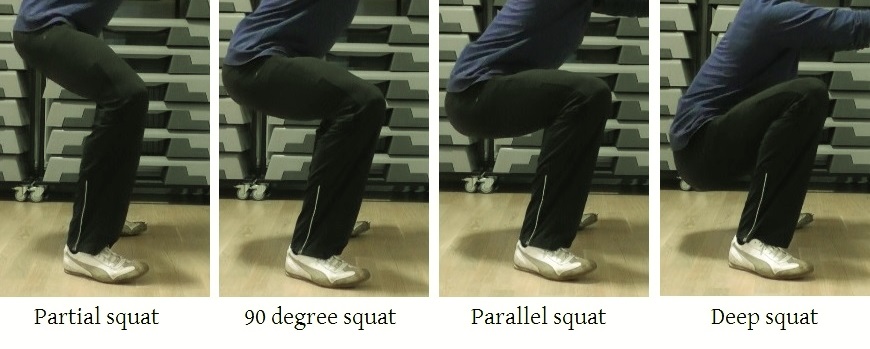
Let’s take a look at squats as this one tends to come up the most. Take a look at this photo below and figure out which one is a proper squat: 

http://darwinian-medicine.com/wp-content/uploads/2017/05/squat-depth.jpg


The answer is they are all squats. The difference between the images is the ROM – the first image has the smallest range and the last image has the biggest range. Each person’s body is different and going to be capable of a different range due to body mechanics, lifestyle, and training goals. The biggest two I want to focus on are lifestyle and training goals as those two go hand in hand (and body mechanics like femur length we can’t do anything about – you got the bones you got and you’re stuck with them). So, which is the squat for you? Here’s a few questions that go through my head when coaching to determine which one we’re looking for:

1. What is your current range of motion? If you can deep squat easily, then deep squat! But if you can only get down to a 90 degree then that is where we start. 

2. If there is an opportunity to increase the ROM, should we? YES. I always try to increase ROM as it generally decreases your chances of injuries when done properly. For example, if you can squat parallel and are strong doing so, then your body is prepared for that movement. But if an unexpected load is added to your back (anything from a barbell to a child jumping on you) and you are suddenly forced into a deep squat it is probably an injury could occur. The soft tissues like joints and ligaments are not prepared and can tear or get strained as they get forced past their range of motion.

3. What is the purpose of your training? When you are doing any exercise you should know ‘why’. If you are doing barbell squats to burn calories but you can’t get down to parallel, that’s okay! Getting down to 90 is still going to use your legs, burn lots of calories, work up a sweat and strengthen your legs. Same thing for hypertrophy – if your goal is build muscle and burn fat, sometimes smaller range of motion will focus more on the belly of the muscle and get you more of a pump. But if your goal is to do a competition (for example a powerlifting competition) then there are standards for each lift including passing parallel on your squat and you need to train as so. I often see videos posted online of “squat personal records” with the caption saying the person is “still working on depth”. If it’s for your own personal fitness and meets your standards then that is no problem! Where you run into arguments is when people don’t agree on the standard. To someone who judges squat records like a powerlifting competition, then squatting a big weight but not hitting depth does not count. It’s like running 8 kilometers and saying your time is your new “10 kilometer personal record” but you are “still working on distance”.

The main point is – depending on what your goals are don’t let a lack of ROM stop you from trying or getting started. You have to build up strength in a partial squat before you can do a 90 degree squat, and so on. This translates over to all movements – if you are looking to burn calories and get a good cardio workout and your workout calls for burpees but you can’t do a burpee, who cares! Hip hinge, walk yourself down to the ground, lower down, do a push up from the knees and stand back up, then raise your hands over your head. Work within the range you have and actively try to increase it as you improve and get stronger, but don’t let it stop you in the meantime! Good programs and coaches will balance the demand they are asking of your body with the capacity your body has. As we get stronger and more flexible our capacity increases and then we can increase the demand accordingly.

Supercompensation Cycle!

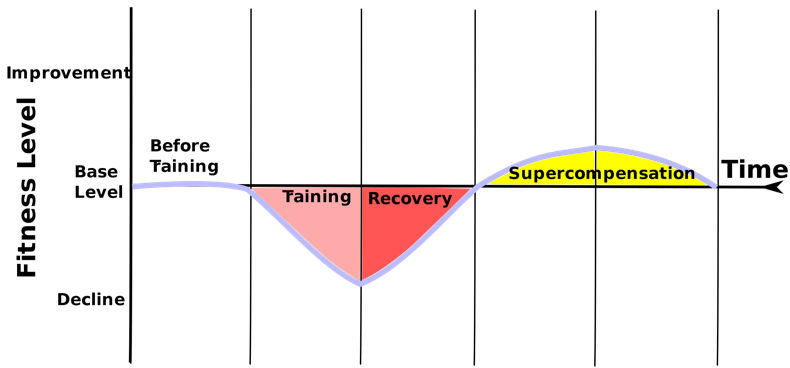
After last week’s blog on rep ranges and which ones to pick for what goals, the next logical step is how to then use those rep ranges effectively (i.e. “I want to grow my legs so I should use the hypertrophy rep range, but how many times a week should I do that and when should I take rest days?”). I want to continue to hammer in the importance of consistency in your exercise and why taking a few days off to wait for optimal training conditions might be inferior to doing smaller, less exciting workouts every day. The way we do both is by looking at the supercompensation cycle.

When I was looking for some good photos I came across this little blog that summarized it extremely well: (excerpt from “What is Supercompensation Theory and Why Should You Care?” by John Ferry, June 15 2020)

What is Supercompensation Theory

Supercompensation theory states that when an appropriate training load is applied to an athlete, followed by an appropriate recovery, the athlete’s body not only returns to the previous baseline, but supercompensates in order to be prepared for a greater future training load.  There are four main phases to this theory.

A close up of a logo

Description automatically generated with medium confidence

  1. The first phase is the application of training stimulus to an athlete.  As mentioned before, it’s incredibly important that the intensity of this training be appropriate for the athlete.  Training loads that are too intense will result in difficulty returning to base level.  Similarly training loads that are too easy will result in little to no adaptation.   
  2. The second part of the cycle is recovery.  Supercompensation theory only works when the athlete fully recovers from the training stimulus and has peaked into a supercompensation zone.  If an intense training stress is applied too soon after the initial training, not only will the athlete miss the benefits of supercompensation, but will lower their overall base level.  Repeatedly overtaxing the body without properly recovering often leads to plateaued or declining performance. 
  3. Supercompensation.  If an appropriate training load has been applied, followed by an adequate amount of recovery, your body enters your supercompensation window. This adaptation to the initial training stress allows the athlete to execute at a higher level than before. If the proper training ratio of work to recovery is executed the result should be a continual wavelike training graph that leads to greater performance. 
  4. The final phase of the cycle is detraining.  If the next training load is too easy, or too long after the initial session the supercompensation window will be missed.  If there is a continual pattern of workouts that are too easy or too sparse the athlete’s base level will start to decline.  This is an important factor to consider when backing off intensity or entering your off-season. 

So! The main points to take from this are: training stimulus (weights/load) needs to be challenging and we need to rest and recover BUT we can’t do it for too long. Hitting legs on Monday, letting them rest on Tuesday, and then hitting them again on Wednesday is great – waiting till Saturday to do them again is not. You will have applied stimulus, recovered, but missed the window for growth, and we end up in this endless cycle of returning back to baseline over and over again. This is MY personal main piece of motivation. I will not allow myself to skip my Wednesday workout because if I do, the pain I went through on Monday’s workout was kind of wasted. On the flip side, this DOESN’T mean that if you miss a workout then it’s all ruined – it’s cumulative. Getting sick, taking a few days off, needing an extra rest day, those things are going to happen, it’s just making sure it isn’t happening every single week. And even so, if you can only manage to get in one workout a week, that’s still better for your health than not getting any! Just expect to see better and faster results the more consistent you are. General fitness is much easier to maintain then a specific training goal, and both are perfectly acceptable. It’s just the difference between going for a run once or twice a week for enjoyment and health, versus training specifically for a marathon. 

This is also why I program a lot of full body days versus “chest day”, “back day”, etc. Training chest once a week is going to be a lot slower for results than hitting it 2 or 3 times a week, so you’ll see maybe bench press on one day, push ups a day or two later, and chest flys and dumbbell presses another day or two later. Same with legs, squats one day, deadlifts another, and split movements in between, instead of just one day for legs a week.  It also makes the program more resilient, where if you only get in 2 out of 4 days, you still hit all the muscles at least twice in the week – if you only train chest once a week and miss one, that’s two full weeks before you’d hit it again. 

TLDR: Train all your muscles multiple times a week, and rest when you need to but try not to take more than 1-2 days off!

Determining Rep Ranges

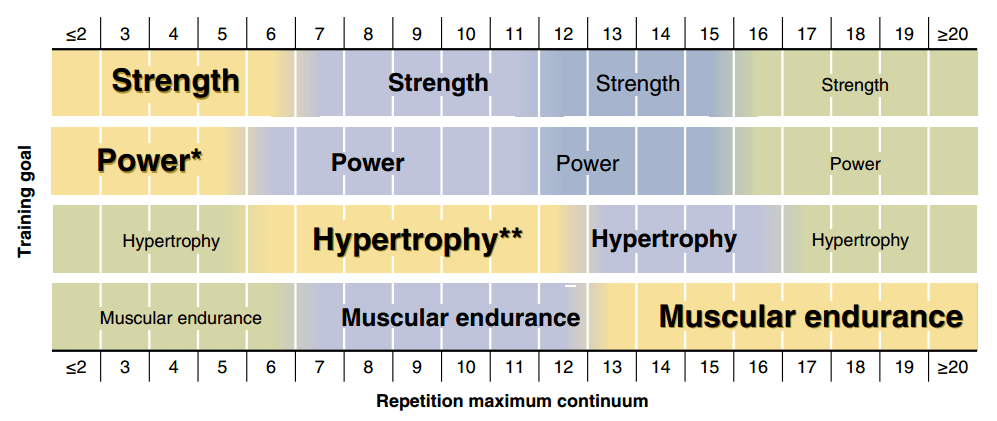
The nice thing about having someone program for you is being told how many sets and reps to do for each exercise. But how does your coach know what to tell you to lift? Why does one person get a 5×5 at 80% of their 1RM and another gets 3×20 to failure? It all comes down to how the body responds to the stimulus and what our goals are. Take a look at the image below: 

Image from https://www.m8north.co.uk/blog/using-the-3-5-rep-range/

This chart (or any chart like it) is going to be your basis of all programming. We have our rep ranges at the top from <2 to >20 (less than 2 to over 20), and a colour representation for how each rep range relates to developing Strength, Power, Hypertrophy and Muscular Endurance. Before we go any further, let’s make sure we define each of those in basic terms so we know what we’re talking about: 

Strength – related to physical strength, how much you can lift, increased central nervous system control over of the muscle fibers you have

Power – related to explosive strength, how fast you can generate force 

Hypertrophy – breaking down and rebuilding of new muscle fibers to increase mass

Muscular Endurance – how long the muscles can work before they lack oxygen, run out of energy, or have too much lactic acid build up and need to stop and rest 

Now that you know what each of those things are, another important thing to notice is that every rep range works on all four of those aspects of training, but some rep ranges are more effective (yellow indicating the most effective, blue moderate, and green the least).  You can see for strength and power that the most effective range is the <2 to 5-6 reps, and anything 16 or more is ineffective. Muscle endurance is the opposite, and hypertrophy falls in the middle. So when you first start working out, this is why the 12-15 rep range is a great starting place – it’s highly effective for endurance, while being moderately effective for hypertrophy, power and strength – the best of all four worlds. You really can’t go wrong with the 12-15 rep range and I like to start with it as an indicator of where we are fitness wise. 

So where do we go from here? This is where programming comes into play, and why you’ll see different programs from different trainers – this information is the basis of the workout, but how you apply it to each person individually is where the work comes in. For example, if you come to me and say you want to do powerlifting and want to train for a 1 rep max, what would you do? You would probably look at the chart and say, “I want to train for strength, so I’m going to train in the <2 to 5-6 rep range,” right? Seems logical and might be the right choice. But let’s say you haven’t done much powerlifting, and I can see that your form is not the best, and after your 3rd set of deadlifts your low back is buckling, and now the weight is struggling to get off the ground. This would indicate a “strength” problem, right? Maybe. Or, it might indicate a muscular endurance issue with your low back, core and glute muscles if your form started out okay and degraded as the reps went on. We would do some screening and tests to determine what is breaking down and why. Before we get into a strength block, we might need to do a muscular endurance block first to build up the endurance in the muscles so that you can properly perform the strength portion later. This is why we’re always evaluating and why we fluctuate up and down in weights and ranges every month. As we notice something improving, we will also notice what is now lagging behind (there will always be a weakest link in the chain and we’re constantly trying to improve them all). 

This is the same reason as to why we cycle through things. You might want to start with some higher rep ranges to build up endurance, then as you improve move to some moderate rep ranges to increase our muscle mass and get stronger, then drop to the lower reps to maximize our strength – and repeat. You’ll max out your strength on what you have and then you start over. Back to endurance, add a little more muscle again, maximize strength. Repeat. If you only ever do high reps, you will burn calories but never get stronger. If you only do strength you will not burn many calories, and not see much muscle growth and will plateau on your numbers. Hypertrophy is the best mix of both and you’ll get pretty fit, but will never see maximum strength or endurance performance.

It’s up to you and your coach to always be assessing and changing programs as you and your body grow and adapt. The sign of a good coach is someone who has your goals in mind and listens to you – I would not make you do powerlifting training if your goal is to complete a marathon – the chart explains why and it should also be obvious. When you receive your programs you should be able to look at them and say, “This makes sense for me and my goals” and if it doesn’t that’s a problem!


Hope this was helpful and next week we will get into supercompensation!