
We all know that sleep is good for us. When we get a quality full night’s sleep we see a host of benefits we feel immediately (“Wow! I actually feel rested today!”) and a whole bunch of other benefits working behind the scenes. I recently got a Fitbit for my birthday to track my sleep and recovery as even though I eat relatively healthy, workout in a balanced manner, and supplement with vitamins and nutrients, I still feel like something is missing. I rarely feel recovered or ready for the next day and I wanted to start figuring out why.

First, let’s recap some of the known benefits to sleep (https://www.sclhealth.org/blog/2018/09/the-benefits-of-getting-a-full-night-sleep/):
1. Improves our Immune System Function – our immune system needs time to rest and recover just like we do, to help fight off colds and flus and other forms of sickness
2. Helps Reduce Potential Weight Gain – when you don’t sleep your body produces ghrelin (the “hunger hormone” that stimulates food intake and fat deposition) and decreases production of leptin (mediates energy balance and suppresses appetite). So if late-night snacking is an issue for you, a lack of sleep could be partially involved.
3. Sleep Reduced Wear and Tear on your Heart – The less you sleep the more cortisol (stress hormone) is released, and high stress damages your cardiac muscles over time.
4. Sleep Improves Mood, Productivity, Safety and Strength – Sometimes we have to stay up late to finish work but it’s not a habit we want to get into. A full night’s sleep makes us less grumpy and increases our concentration the next day, resulting in an overall more productive day. Along with the increased focus, a study from the AAA Foundation for Traffic Safety found you are twice as likely to get into an accident when you’ve only had 6-7 hours sleep versus 8 as our reaction time slows down when we are not rested. Finally, our exercise performance is affected as well as our coordination and muscle recovery take a hit.
5. Sleep Improves Memory – When we sleep our brain is processing and consolidating our memories from the day, and if this is interrupted we could lose those memories or create false memories.
Most of these things we already know and I don’t think anyone is arguing that sleep ISN’T good for you. The problem is usually more: “I can’t fall asleep”, “I’m constantly waking up”, “I toss and turn”, or simply having too busy a schedule to get in 7-8 hours. I’m sure we are all aware of the tips/tricks to get better sleep: Reduce alcohol and caffeine to at least 3 hours before bed, keep your room dark and cold, avoid your phone/blue light for 1-2 hours before bed, do deep breathing exercises, etc.” The question is do they really work? Well, I think the answer is (more or less) yes. I want to show you my personal sleep data from the last few nights to draw some conclusions from.
If you were to ask me what night of the week I get the best sleep my answer would be… what? I’m sure for those of us with Monday-Friday jobs, where Saturday gets busy catching up on errands from the week, the answer for most of us is Saturday night. We can usually sleep in on Sunday, catch up on sleep, and wake up feeling refreshed on Sunday morning. I would have bet money on this no problem. Normally through the week the Fitbit was giving me a sleep score of “Good” which was a rating of over 80-85/100, so I was pumped to see what my Saturday night score would be, not having to get up early and being able to just sleep to my heart’s content. Here is what I got:
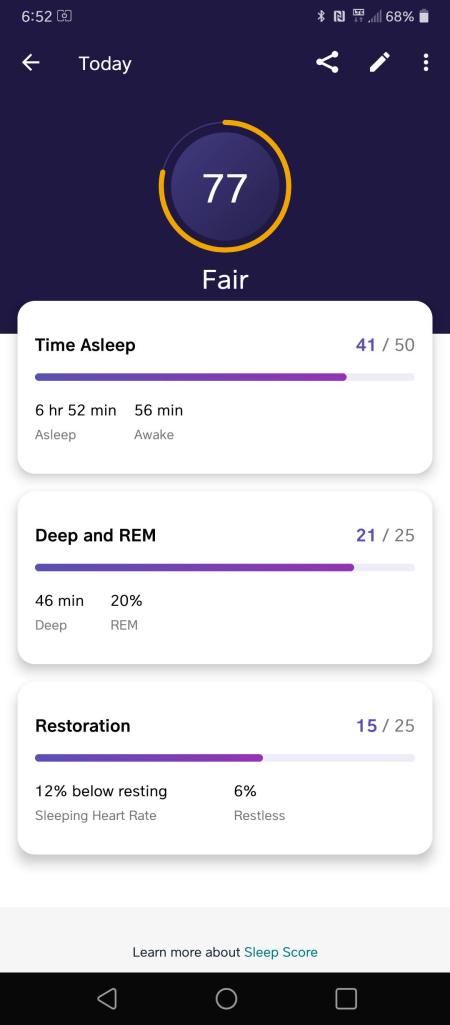
I was expecting a 85/100 or higher and a rating of GREAT and instead Saturday night, the one I was banking on to refresh me, was my worst sleep of the week. I was in bed for 8 hours – 6 hours and 52 minutes asleep and 56 minutes awake (normal amounts), my deep and REM sleep was okay, but my restoration score (the quality of the sleep) was really not good. So while I was asleep the longest out of the week, my 8 hours in bed was less restorative than the 6.5 hours I was getting during the week. WHY??
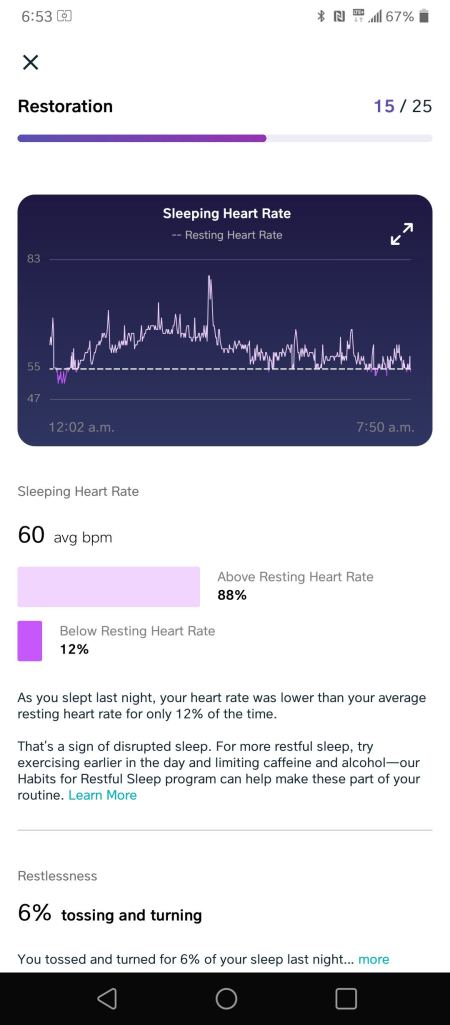
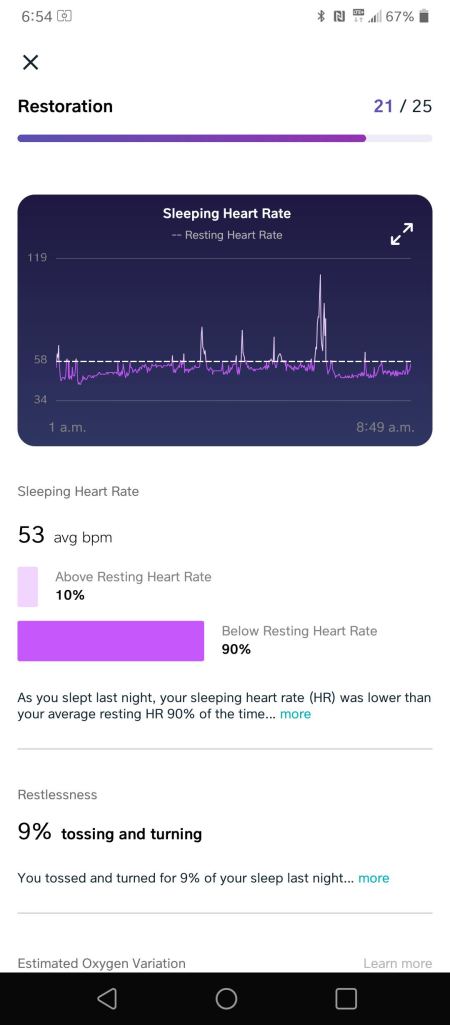
These are my Saturday night and Sunday night restoration results. Saturday is on the left: Almost the entire night my heart rate was above my resting heart rate (55 bmp) which means even though I was asleep, my body was still trying to wind down from the day. On Saturday night I had 2 beers, finishing my second one about 30 minutes before bed, and was playing a high-stress game on the computer (blue light, not winding down), right up until bed. You can see the direct result it had on my sleep – my body was still stressed out on alcohol and stimulation ALL NIGHT. The tracker also gives you a readiness score for the next day (i.e. Are you recovered enough to workout again the next day) from 1 to 100 and my score was… 4. That is dismal, I basically didn’t rest at all even though I slept 8 hours. So Sunday I decided to try no alcohol, stop gaming for an hour before bed and switch to an episode of TV that was more relaxing and the screen is farther away from my eyes, and made a small chamomile tea to sip on. The results this morning? Even though I slept 1 hour less, my heart rate was 6 points lower for 92% of the night, and I was actually at rest and recovering! That also means Sunday night put about 80% less stress on my heart muscles versus Saturday night. I woke up feeling more rested and relaxed this morning than sleeping in yesterday. My readiness score as well has bumped up to 24/100 – still not great, but we’re on the way up from a 4.
So you can see why sleep is so important, even just from the stress side alone – if I’m having sleeps like Saturday night every night, I’m going to burn my heart out early and put myself at higher risk for heart attack and heart disease. Not to mention never recover, always be tired, have my hormones out of whack, not be able to concentrate or be productive causing me to fall further and farther behind, always be too tired to exercise, and the list goes on. The take-away from today – NOTHING IS MORE IMPORTANT THAN GETTING QUALITY SLEEP. For those of you in the back, NOTHING IS MORE IMPORTANT THAN GETTING QUALITY SLEEP.
In conclusion, it seems anecdotally and unfortunately that my suggestions for better sleep are the same as we’ve been toting: limit alcohol and caffeine to at least 3 hours before bed, get away from the computer and phone/tablet screens a minimum 1 hour before bed, have a nice relaxing herbal tea or hot bath/shower before bed, don’t look at the news or Tiktok or any “junk food” media (this is just a good rule in general), and get aggressive and defensive about your personal health. Just because someone else at work can’t get their things done on time and it falls to you, remind yourself that picking up their slack is literally taking days off at the end of your life, and it is not worth it.
Also – TAKE NAPS! If you feel like you need one, and you can fit one in, any extra sleep is better than nothing!
 fitbusiness.ca
I’ve averaged 1-4 hours of sleep every night since September… mostly due to anxiety and not having a job (coming up on two years unemployed now). Even with the above, my brain cannot seem to shut off. You’d be surprised how little a person who is awake 20+ hours a day gets done in that time (and, for the record, I’m IN bed trying to sleep 8-12 hours a day)
LikeLiked by 1 person
Agreed, there’s definitely a big difference between “being awake” and not being able to sleep for productivity, so even though you are up 20+ hours I’m sure it’s in no way what you want to be doing. I’m sorry to hear its been such a rough go ❤ Especially when you are making the effort to try and rest and theres external stressors that you can't seem to get away from.
LikeLike